
Swedish or Danish Furniture? An Honest Comparison



In Germany, “Danish furniture” has become the collective term for Scandinavian vintage. Anyone looking for a teak sideboard from the 1960s is looking for Danish design, even if the piece comes from Sweden. There are historical reasons for this, and it has consequences for the price. In this article we compare Swedish and Danish furniture honestly: design language, makers, quality, availability and cost. And we explain why Swedish pieces from the 1920s to the 1960s are currently the underrated choice on the German market. You will find the place of the styles in the guide Scandinavian vintage furniture.
Why Germans say “Danish” when they mean Scandinavian
In the 1950s and 1960s, Denmark exported furniture on a large scale, above all to Germany and the USA. Makers such as Fritz Hansen, France & Søn and Carl Hansen built for export, and designers such as Hans J. Wegner, Finn Juhl and Børge Mogensen became brands. What arrived in German living rooms was Danish, so “Danish” became a synonym for the region. In the same years Sweden exported little. The domestic market was large enough, and the industry in Småland and Västergötland worked for Swedish customers. That is why Germans know IKEA and Svenskt Tenn, but not Bodafors, Tibro or Nordiska Kompaniet, which set the tone in Sweden.
Design language: sculptural versus homely
Danish furniture is sculptural. Wood joints are shown, backs carved, construction made a theme. The Wishbone Chair or the Chair 45 are objects to be looked at. Swedish furniture of the same period is more homely: softer forms, more storage, fabrics, flaps and pull-outs. The Swedish ideal was the good home, not the masterpiece. This attitude goes back to the 1920s, to so-called Swedish Grace, and to the 1930s and Swedish Modern, which shaped the term “Scandinavian Design” in America long before the Danes took it over. We describe the era from 1950 onwards in the article Mid-century furniture.
Quality: no difference, except in reputation
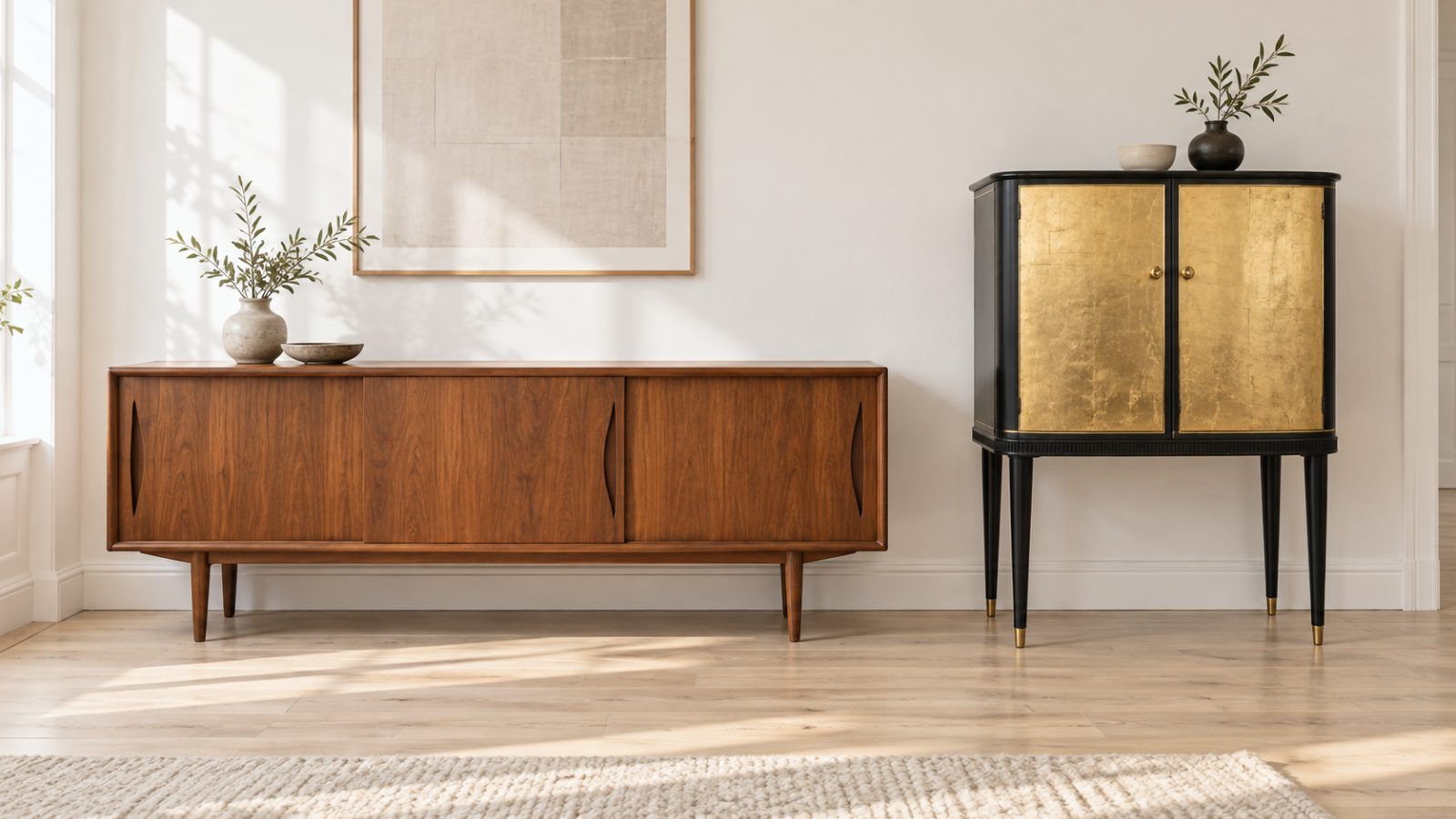
In build quality, Swedish and Danish furniture of the period are evenly matched. Both countries had a joinery tradition, both used solid wood and real veneer, both dovetailed drawers and grooved in back panels. The difference lies in reputation, and reputation makes the price. An anonymous Danish teak sideboard costs €1,500 to €4,000 in Germany, the same piece from Sweden €400 to €1,200, because nobody is looking for it. With signed pieces the gap is even wider.
What Sweden has that Denmark does not
- The Gustavian style. The painted, classicist furniture of the eighteenth century, which Germans look for as Scandinavian country style, is a purely Swedish tradition.
- Swedish Grace and Swedish Modern. Two eras before teak, with marquetry, pale veneer and interiors that did not exist in Denmark in this form. Most of our drinks cabinets come from here, such as the drinks cabinet in the Swedish Grace style and the drinks cabinet with gold leaf in the Swedish Modern style.
- Josef Frank. The Viennese architect who designed for Svenskt Tenn in Stockholm from 1934 and whose fabrics we still use today on benches and chairs, as on the grey Gustavian bench.
- The variety of furniture types. Drinks cabinets, display cabinets, bureaux, bedside tables in series that never reached the German market.
What Denmark has that Sweden does not
In fairness: the Danish seating furniture of the 1950s is unrivalled. Anyone who wants an armchair by Wegner or Juhl will find no Swedish substitute. And the Danish market is deep; spare parts, restorers and expert opinions are easy to come by. If you collect, you collect Danish. If you live with it, you can choose Swedish and save.
Our recommendation
For storage furniture, that is sideboards, chests of drawers, drinks cabinets, display cabinets and cabinets, Swedish originals from the 1920s to the 1960s are currently the better deal: the same quality, often more interesting interiors, half the price. Restored and redesigned, mostly in black with brass or gold leaf, they become pieces that will not be found a second time in any German home. You will find all available furniture under All pieces for sale, and why we restore rather than build new in the article Why restore rather than buy new.
Frequently asked questions
How can I tell whether a piece comes from Sweden or Denmark?
By the stamp: Danish pieces often bear “Danish Furniture Makers’ Control” or maker names such as France & Søn, while Swedish stamps are from Bodafors, Tibro, NK or “Svensk Möbelindustri”. Without a stamp, the form helps: sculptural and in teak suggests Denmark, homely with an interior and in birch suggests Sweden.
Can Swedish vintage furniture be delivered in Germany?
Yes. We deliver every piece by furniture haulage, directly from our workshop in Stockholm. Details on shipping and withdrawal are on the page Shipping, right of withdrawal & returns.
Is IKEA Scandinavian design?
IKEA has been Swedish mass-market design since 1943 and democratised the design language of Swedish Modern. Apart from its origin, it has little in common with the hand-built vintage furniture we are talking about here.