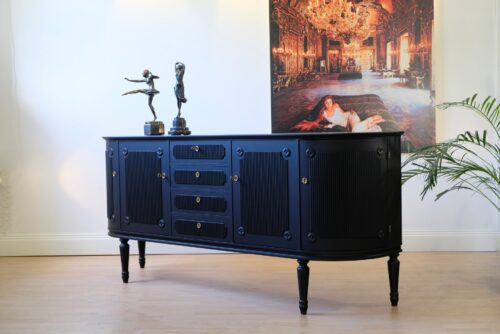
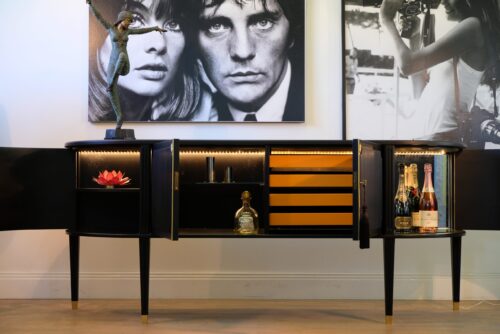
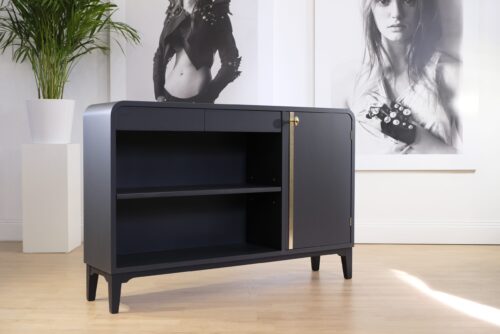
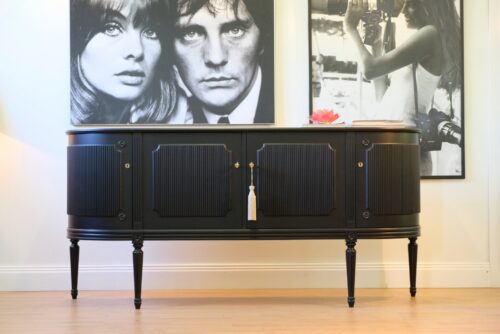
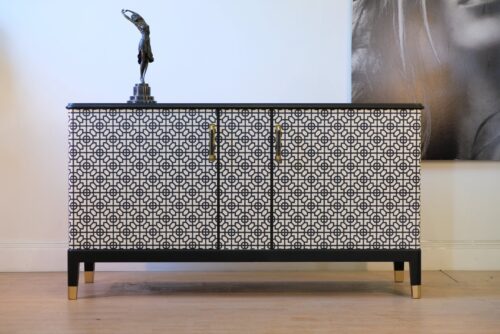
There is something magical about furniture that has survived for decades. It carries stories from a time when quality was not an option but a matter of course.
We have specialised in rescuing and refining sideboards from the 1930s and 1940s – pieces that are returned with a gentle hand to a condition that rivals today’s new production. We also work with sideboards from the 1950s and 1960s, which are often made of teak and look all the more modern for their more elegant, straight lines.
Buying one of our sideboards is not just an interior decision but an investment in sustainability and character. We seek out the finest examples in walnut, birch and oak and give them new life through a comprehensive restoration process:
Craftsmanship down to the smallest detail: We sand away decades of wear and bring out the natural lustre of the wood. A world-class finish: With modern technique and traditional methods we create surfaces that feel silky and look like new – with that deep patina that only 80-year-old wood can offer. Functional perfection: We make sure doors glide, drawers run smoothly and fittings shine. It should not only look new – it should feel new too.
A little background on the different design styles:
Antique sideboards from the 1930s and 1940s represent an exciting period of upheaval in design history. Here the heavy, ornamented furniture was left behind and design moved towards what we now call “modern classicism” and early functionalism.
In the 1930s Swedish furniture design reached one of its absolute high points, often called Swedish Grace. Sideboards from this period rarely look clumsy; instead they rely on proportion and craftsmanship.
Choice of materials: Exclusive woods such as birch, elm and mahogany were often used, along with, at times, fine marquetry (patterns inlaid in wood). Form: The legs were often slender and slightly flared. Fittings in brass or pewter lent a luxurious but restrained feel. Art Deco influence: Towards the end of the 1930s we see more rounded corners and mirror-smooth surfaces, inspired by the international Art Deco movement.
With the 1940s the style changes. The war years affected the availability of materials, and design became more practical and robust. This is where the foundation of what we now call “Scandinavian design” was laid. Practical storage: Sideboards became more functional, with well-considered interior divisions for linen, cutlery and tableware. Now the piece moved into the dining room for good as its centrepiece. Softer forms: The style of the 1940s is sometimes called “Folkhem architecture”. The furniture looks warmer and less severe than the elegant pieces of the 1930s. Pale wood: Pale woods such as oak and birch dominated, often with a more matt finish than the earlier high-gloss variants.
Sideboards from the 1950s and 60s were created at a time when form and function went hand in hand and the choice of materials – often beautiful teak, oak or rosewood – had a quality rarely seen today. With time and use come scratches, rings and dull patches; here we help give these icons new life with a surface that is almost as good as new.
To provide the best experience, we use technologies such as cookies to store and/or access device information. Consenting to these technologies allows us to process data such as browsing behaviour or unique IDs on this site. Not consenting or withdrawing consent may adversely affect certain features and functions.
Functional
Always active
The technical storage or access is strictly necessary for the legitimate purpose of enabling the use of a specific service explicitly requested by the subscriber or user, or for the sole purpose of carrying out the transmission of a communication over an electronic communications network.
Preferences
The technical storage or access is necessary for the legitimate purpose of storing preferences that are not requested by the subscriber or user.
statistics
The technical storage or access that is used exclusively for statistical purposes.The technical storage or access that is used exclusively for anonymous statistical purposes. Without a subpoena, voluntary compliance on the part of your Internet Service Provider, or additional records from a third party, information stored or retrieved for this purpose alone cannot usually be used to identify you.
marketing
The technical storage or access is required to create user profiles to send advertising, or to track the user on a website or across several websites for similar marketing purposes.