
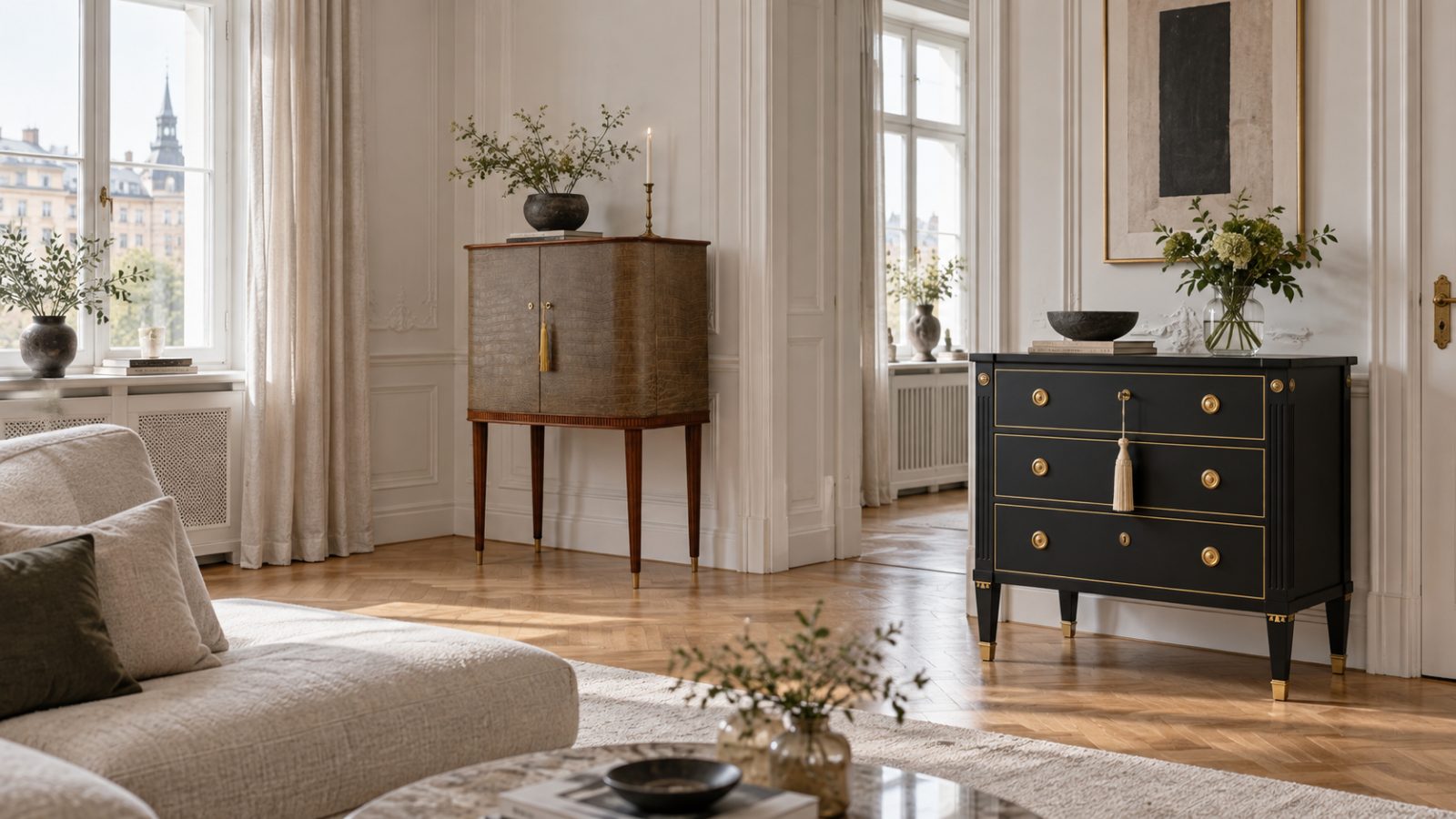
Scandinavian Vintage Furniture Guide: Styles, Eras, Origins and How to Recognise Originals

Scandinavian vintage furniture is in demand in Germany as never before, yet the term is mostly equated with Danish teak of the 1960s. The history of Scandinavian furniture is in fact broader and older: the Swedish classicist tradition of the eighteenth century, the elegance of the 1920s, the soft modernism of the 1930s and 1940s and only then the teak era. This guide sorts out the styles, explains how to recognise Scandinavian originals, what sets them apart from German goods and why a restored piece from Sweden is often a better choice than a new reproduction. Almost everything we restore and redesign at Plan B Design in Stockholm comes from this history.
What defines Scandinavian furniture
Across all eras, Scandinavian furniture shares four characteristics. Pale wood: birch, beech, pine and elm in the north, with teak and rosewood only from the 1950s as imported timber. Reduced form: ornament is sparing, proportion is everything. Craftsmanship: dovetailed drawers, grooved-in back panels, veneer on solid wood rather than on chipboard. And practicality: furniture for flats, not for palaces, with flaps, pull-outs and interior lighting. What else you should know about quality is in the article on the luxury drinks cabinet, which explains the criteria by example.
The styles at a glance
Gustavian and Scandinavian country style, from 1770. The Swedish answer to Louis XVI: straight, fluted legs, symmetry, painted finishes in pearl grey, white and blue. What Germans now look for as Scandinavian country style is, at its core, this design language. More in the article Scandinavian country style.
Swedish Grace, 1920s. The Swedish classicism of the twentieth century: slender proportions, marquetry, fine veneers, restrained elegance. Hardly known in Germany, but the root of everything that came after. Explained in What is Swedish Grace? and Swedish Grace: design between classicism and modernism.
Art Deco, 1920s to 1930s. The international variant of the same period: more gloss, more geometry, more contrast. Scandinavian Art Deco furniture is more matter-of-fact than French. Everything about it in the article Art Deco furniture and in the comparison Swedish Grace vs. Art Deco.
Swedish Modern, 1930s to 1950s. Soft functionality in pale wood, without ornament, with fabrics by Josef Frank. The movement that shaped the term “Scandinavian Design” in America before the Danes took it over.
Mid Century, 1950s to 1960s. Teak, rosewood, splayed legs, drop-down fronts. The era most people mean today when they say Scandinavian vintage furniture. In the article Mid-century furniture we explain what distinguishes Swedish from Danish pieces.
Swedish or Danish: why it makes a difference
“Danish furniture” is the term most Germans use for Scandinavian vintage, because Danish manufacturers exported heavily to Germany in the 1960s. Sweden exported less and had an older, broader tradition. The result: Swedish pieces from the 1920s to the 1940s are rarer on the German market, often better built and considerably cheaper than Danish teak classics, because nobody is looking for them. You will find the comparison with all the criteria in the article Swedish or Danish furniture?.
How to recognise a Scandinavian original
- Stamps and labels: Nordiska Kompaniet, Bodafors, Tibro, Svenskt Tenn, Gemla on Swedish pieces; often under the seat or behind a drawer.
- Types of wood: birch and elm are typically Swedish, while teak and rosewood point to the 1950s and 1960s, whether Sweden or Denmark.
- Construction: dovetailed drawers, back panels of plywood or solid wood in grooves, no chipboard.
- Dimensions: Scandinavian furniture is built for small flats, mostly narrower and taller than German goods of the same period.
What we do with the furniture
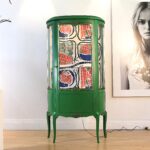
We buy in Sweden, restore in our workshop in Stockholm and redesign: surfaces are stripped and repainted, mostly in black with brass, gold leaf or hand-painted patterns, fittings are refurbished, lighting and mirrors renewed. The form remains Scandinavian, the expression becomes contemporary. Examples: the drinks cabinet in the Swedish Grace style, the Gustavian sideboard with brass and the green Gustavian display cabinet with a Josef Frank motif. What exactly happens in the workshop is shown on our Restorations page, and the thinking behind it is explained in the article Redesigned furniture.
Restored original or new reproduction?
Scandinavian furniture is now reproduced in large numbers, mostly in veneered MDF and in Asia. An original from the 1920s to the 1960s is made of solid wood and real veneer, has proved itself through the first half of its life and is one of a kind. Restored and redesigned, it costs between €900 and €3,850 with us depending on the type of furniture, including VAT and free delivery by freight within Germany. Why this adds up better is explained in the article Why restore rather than buy new. You can see all available pieces under All pieces for sale.
Frequently asked questions
What is the difference between Scandinavian and Nordic style?
None in substance. “Nordic” includes Finland and Iceland, while “Scandinavian” strictly speaking covers only Sweden, Norway and Denmark. In the furniture trade, both terms are used in the same way.
Is Swedish vintage furniture cheaper than Danish?
As a rule yes, at comparable or better quality. Danish design classics by names such as Wegner or Juhl fetch collectors’ prices; Swedish pieces from the same years are mostly anonymous and correspondingly cheaper.
Does Scandinavian vintage furniture suit a modern interior?
Better than almost anything else. The reduced form was ahead of its time and looks entirely natural in today’s rooms. How to make a piece the centre of attention is described in the article Furnishing with statement pieces.