
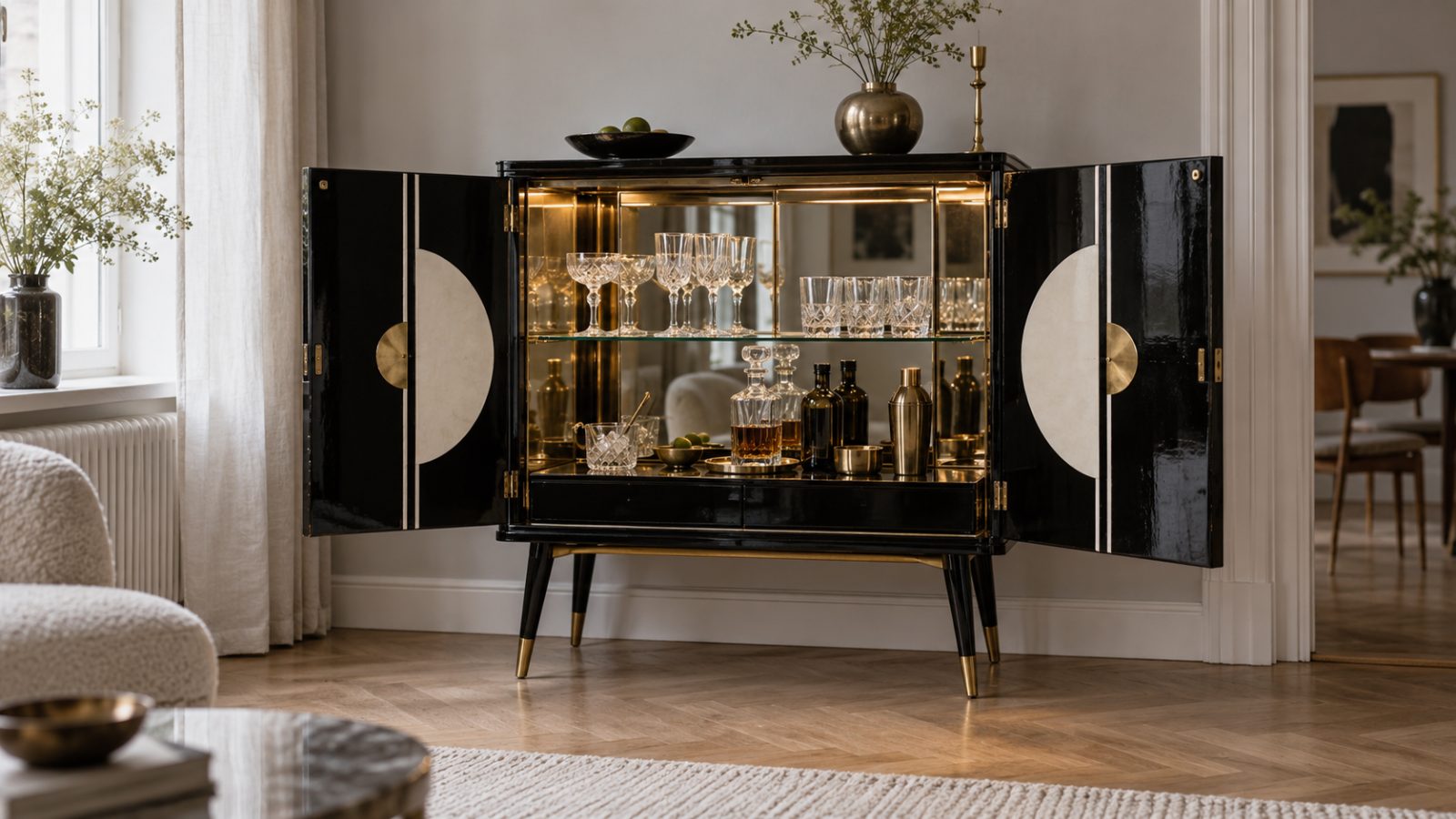
Drinks Cabinet Guide: Types, Eras, Dimensions and What to Look for When Buying



A drinks cabinet is more than a cupboard for bottles and glasses. It is the piece of furniture where the evening begins, and usually the first thing guests look at. This guide explains which types of drinks cabinet exist, how to recognise the eras, which dimensions work in everyday life, and why a restored vintage drinks cabinet is often a better choice than a new one. By the end you will know which drinks cabinet suits you.
Drinks cabinet or home bar: what is the difference?
The terms are often used interchangeably, but they do not mean quite the same thing. Home bar is the umbrella term for any bar in your own four walls, from a bar cart to a built-in counter. A drinks cabinet is the closed variant: a freestanding piece of furniture with doors or a drop-down flap, behind which bottles, glasses and accessories disappear when you are not entertaining. That is exactly what makes it so popular in the living room. Closed, it is an elegant piece of furniture; open, it is a complete bar with a mirror, lighting and a shelf.
Which types of drinks cabinet are there?
- The classic freestanding drinks cabinet with two doors and an interior bar. The most common form from the 1930s to the 1960s, usually 120 to 150 cm tall. Inside you will find a mirrored back, glass holders and a pull-out mixing shelf.
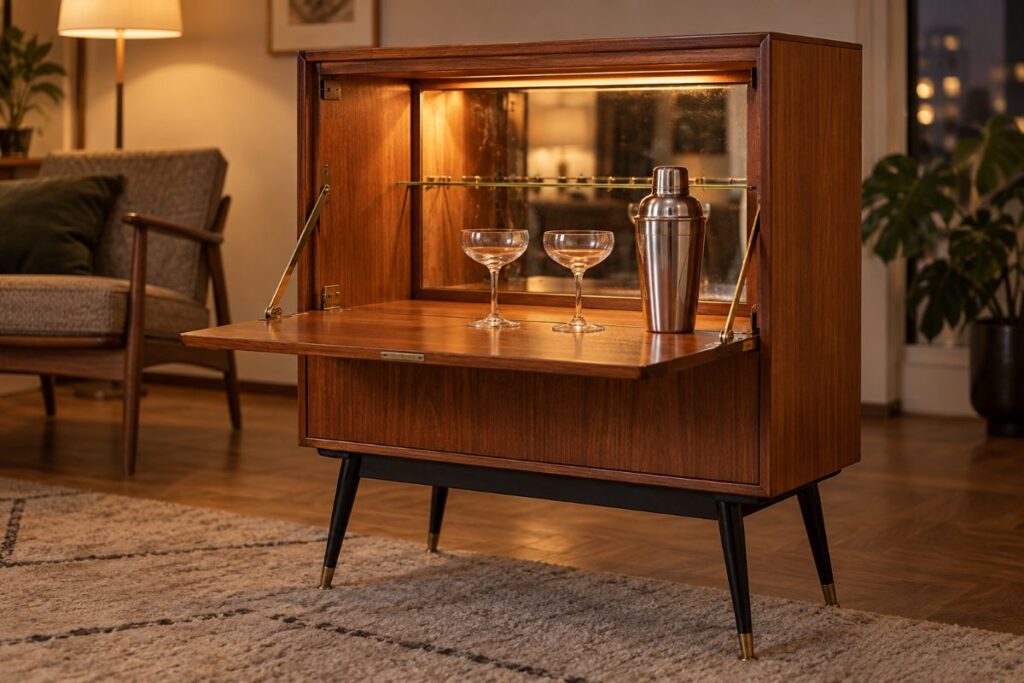
- The drinks cabinet with a drop-down flap. The upper front folds down and becomes a work surface. Space-saving and typical of the 1950s.
- The corner drinks cabinet for small rooms or unused corners. How to fit a full bar into a small space is covered in our article on the small drinks cabinet.
- The bar cart on castors. Open, mobile and quick to dress, but with no storage and without the furniture character of a cabinet.
- The sideboard with a bar compartment. A compromise if you are looking for a long piece for the television or the wall and want the bar to be only part of it.
Recognising the eras: Art Deco, Swedish Modern, Retro
Most of the drinks cabinets traded as vintage today come from three decades. They differ clearly in form and presence.
Art Deco, 1920s to 1940s. Geometric forms, curved fronts, fine veneers such as mahogany or walnut, brass and mirrored glass. The drinks cabinet as a stage. Everything about the characteristics and how to combine them today can be found in our article on the Art Deco drinks cabinet.
Swedish Modern and Swedish Grace, 1930s to 1940s. The Swedish answer to Art Deco: slimmer, more functional, with fine proportions and light or dark veneer. Many of our restored drinks cabinets come from this period, such as the black and white drinks cabinet in the Swedish Grace style or the drinks cabinet with gold leaf in the Swedish Modern style.
Retro, 1950s and 1960s. Splayed legs, drop-down fronts, teak and rosewood, often with interior lighting. More playful than its predecessors and today the most sought-after era. More in the article Retro drinks cabinet from the 1950s and 1960s.
Strictly speaking, anything more than a hundred years old counts as antique. What distinguishes antique, vintage and retro, and what to look out for with genuinely old pieces, is explained in our article on antique drinks cabinets.
Dimensions and interior: what matters in everyday use
Before you fall in love with a piece, measure the space. A freestanding drinks cabinet generally needs 80 to 110 cm of width, 40 to 50 cm of depth and around 130 to 150 cm of height. With drop-down fronts, add 30 to 40 cm projecting forward when open. Also check three things inside:
- Bottle height. Old drinks cabinets were built for smaller bottles. A shelf height of at least 33 cm will also take today’s gin and whisky bottles.
- Mirror and lighting. The mirrored back is the heart of the drinks cabinet and makes glasses and bottles glow. Original lighting should be converted to modern, safe technology during restoration.
- Work surface. A pull-out shelf or flap on which you can actually mix drinks makes the difference between decoration and a bar.

Black, white and gold: colour as a statement
A drinks cabinet is allowed to stand out. That is why at Plan B Design we work mainly with black, often combined with white patterns, gold leaf or brass. Black lets the form of the piece speak, ties it into modern interiors and turns the lit interior into a moment of contrast when you open it. Examples from our workshop: the drinks cabinet with gold diamonds from the 1960s, the black and white patterned drinks cabinet in the Swedish Modern style and the black and white vintage drinks cabinet of the 1960s. How such a piece works as a focal point in a room is described in the article Furnishing with statement pieces.
Luxury drinks cabinet or designer piece: how to recognise quality
The term luxury drinks cabinet says little about the price and a great deal about the execution. You can recognise a high-quality drinks cabinet by four things: solid wood in the carcass instead of chipboard, real veneer with continuous grain across doors and sides, brass fittings instead of coated die-cast zinc, and an interior bar with a mirror, glass holders and worktop that can actually be used. Old drinks cabinets in mahogany, walnut, teak or rosewood almost always meet these criteria, because they were built at a time when wood was the standard material. Repainted and accented with gold leaf or brass, they become designer pieces without a designer premium behind them.
Where the drinks cabinet should stand
The best place is where you receive guests, not wherever a wall happens to be free. In the living room, a drinks cabinet has the strongest effect as a solitary piece against a calm wall, set apart from the television and bookcase. Avoid direct sunlight, which bleaches veneer and lacquer. You will find detailed tips on position, light and combining it with a sofa and sideboard in the article Drinks cabinet in the living room.
Restored rather than new: why it is worth it
There are plenty of new drinks cabinets in a vintage look. Most are made of veneered chipboard and age badly. A drinks cabinet from the 1940s to the 1960s is built of solid wood and real veneer, has already proved itself through the first half of its life and carries a history that no new piece has. With us, every piece is completely restored: surfaces are stripped and repainted, fittings cleaned or replaced, mirror and lighting renewed, hinges and drawers adjusted. The cabinet is then given its own character through colour and details. What exactly happens is shown on our Restorations page, and why it makes ecological and financial sense in the article Why restore rather than buy new.
Price, delivery and how to enquire about a drinks cabinet with us
Our restored drinks cabinets cost between €2,300 and €3,850 including VAT. The price depends on the era, condition and the effort involved in the redesign. Delivery within Germany is free and is made by furniture haulage into the room. Every piece is a one-of-a-kind piece, so there is no shopping basket in the usual sense: you send an enquiry without obligation, and we get back to you with all the details on availability, delivery and payment. You can see all currently available pieces in the Drinks cabinets category. The terms on shipping and withdrawal can be found here.
Frequently asked questions about the drinks cabinet
How big should a drinks cabinet be?
For a household with 10 to 20 bottles and glasses for six people, a cabinet of about 90 cm in width and 140 cm in height is enough. What matters is a shelf height of at least 33 cm for today’s bottles.
What is the difference between a drinks cabinet and a bar cart?
A bar cart is open and mobile, a drinks cabinet is closed and fixed in place. The cabinet offers storage, a mirror and a work surface; the cart is mainly for display.
Can an old drinks cabinet be lit?
Yes. Many drinks cabinets of the 1950s and 1960s had lighting from the factory. During restoration, the old electrics are replaced with modern LED technology with tested wiring, so that the piece is safe and practical for everyday use.
Which era suits a modern interior?
Swedish Modern and Retro of the 1950s and 1960s fit most easily into modern rooms, because their forms are plain. Art Deco is more opulent and works best as a deliberate contrast.