

Wall-Mounted Bedside Tables – When They Suit and What the Alternative Is
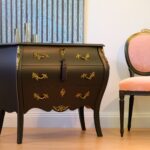
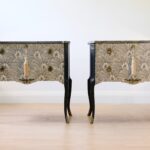
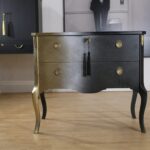

The wall-mounted bedside table is one of the most searched-for types of bedside table and the one people most often regret. The idea is convincing: nothing on the floor, easy to clean, a floating shelf beside the bed. The reality is a shelf at the wrong height, a wall that will not carry the fixing, and a bed that can no longer be moved. In this article we explain when wall-mounted bedside tables are right, how they are fitted, which walls will carry them and when a small free-standing bedside table solves the same problem without drilling holes. We will say it straight away: we do not sell wall-mounted bedside tables, but restored free-standing pieces. You will find everything about bedside tables in general in the bedside table guide.
When wall-mounted is right
- Very narrow bedrooms, where the gap between bed and wall is under 35 cm and no free-standing table fits.
- Robot vacuum cleaners and anyone who wants a completely clear floor.
- Low beds, where an ordinary bedside table would be too tall; a wall-mounted shelf can be fitted at exactly the right height.
- Walls that can carry it: concrete, brick, solid timber or a stud frame behind the plasterboard at the position of the shelf.
When free-standing is better
A wall-mounted bedside table rarely carries more than 5 to 10 kg and has no drawer that can take weight. It hangs at a height that suits one mattress, not the next. It assumes that the bed stays where it is. And it leaves holes in the wall when you move out. A small free-standing bedside table 35 to 45 cm wide needs hardly more space than a wall-mounted shelf, carries everything you put on it, has a drawer for charging cables and glasses and moves with you to the next home. What exists in small formats is described in narrow bedside tables. A bedside table from the 1940s measuring 50 by 30 cm and 57 cm high, of the kind we often restore, takes up 0.15 square metres of floor. That is less than a wall-mounted shelf seems to save.
How to fit a wall-mounted bedside table properly
The height should be level with the top of the mattress, up to 10 cm above it, measured with the mattress under load. The fixing must sit in a stud frame or solid wall with at least two screws, never just with a wall plug in plasterboard. The weight of a lamp, a book, a glass and a hand that steadies itself in the morning is greater than most people think. Use a bracket or a concealed fitting that carries at least 15 kg, and check that the cable to the reading lamp does not lie in the drilling line. If you want to change the height later, choose a rail with a sliding shelf.
The alternative: wall-mounted shelf plus a small table
The combination that works best in small bedrooms: a narrow wall-mounted shelf for lamp and book, 20 cm deep, and a small free-standing table or a small chest of drawers for storage, which does not necessarily have to stand right beside the bed. That way you have a clear floor where you get out of bed and a proper drawer somewhere in the room. Suitable sizes are shown in small chest of drawers.
What we can do for you
We do not make wall-mounted bedside tables, but we restore and redesign small free-standing bedside tables from the 1920s to 1950s that serve the same purpose: 35 to 50 cm wide, 30 to 40 cm deep, as a pair or singly, with a new finish in the colour that suits the bedroom. Examples are the black and white bedside tables in the Louis XVI style (€890 per pair) and the black and white bedside tables in the Gustavian Haupt style (€980 per pair). All pieces are in the category Chests of drawers and bedside tables; we will give you the exact dimensions on request via the contact page.
What to look for when buying
If you decide on a wall-mounted bedside table, look out for three things. First, the load capacity, which the manufacturer should state and which must be sufficient, with a margin, for lamp, book and glass. Second, the type of fixing: concealed fittings look better but often carry less than visible brackets. Third, the wall: before buying, check whether you have a solid wall or a stud frame. If you rent, find out beforehand whether drilling holes is permitted. Anyone who cannot answer these points with confidence is better advised to choose a small free-standing bedside table; suitable sizes are shown in small chest of drawers.
One more point in the interest of honesty: a wall-mounted bedside table is usually a new product of board or metal that is thrown away when you move. A restored old piece, by contrast, keeps its value and can be set up again in any bedroom. That is also one reason why, for small bedrooms, we first look for a narrow free-standing table.
Frequently asked questions
How high should a wall-mounted bedside table hang?
Top surface level with the top of the mattress, plus 0 to 10 cm. Measure with the mattress under load; it sinks 3 to 5 cm.
How much weight does a wall-mounted bedside table hold?
With proper fixing in a stud frame or solid wall, 10 to 15 kg. In plasterboard with a wall plug, considerably less, and that is where most of them fall off.
Can you hang an old bedside table on the wall?
Technically yes, with a French cleat on the back, but the weight of 8 to 15 kg plus contents demands a solid wall. We advise against it: an old bedside table is built to stand.