
Wooden Bedside Tables – Oak, Birch, Mahogany or Walnut
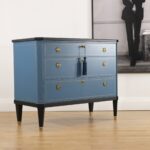
Wooden bedside tables are what most people mean when they say "bedside table": oak, walnut, birch or mahogany, with visible grain or beneath lacquer. The type of wood determines how the table ages, how it copes with a knocked-over glass of water and which period it comes from. In this article we go through the common woods, explain how to tell solid wood from veneer and chipboard, when the wood should stay visible and when it should be lacquered over, and which old wooden bedside tables deserve restoration. You will find everything about bedside tables in general in the bedside table guide.
The woods and what they tell you about the table
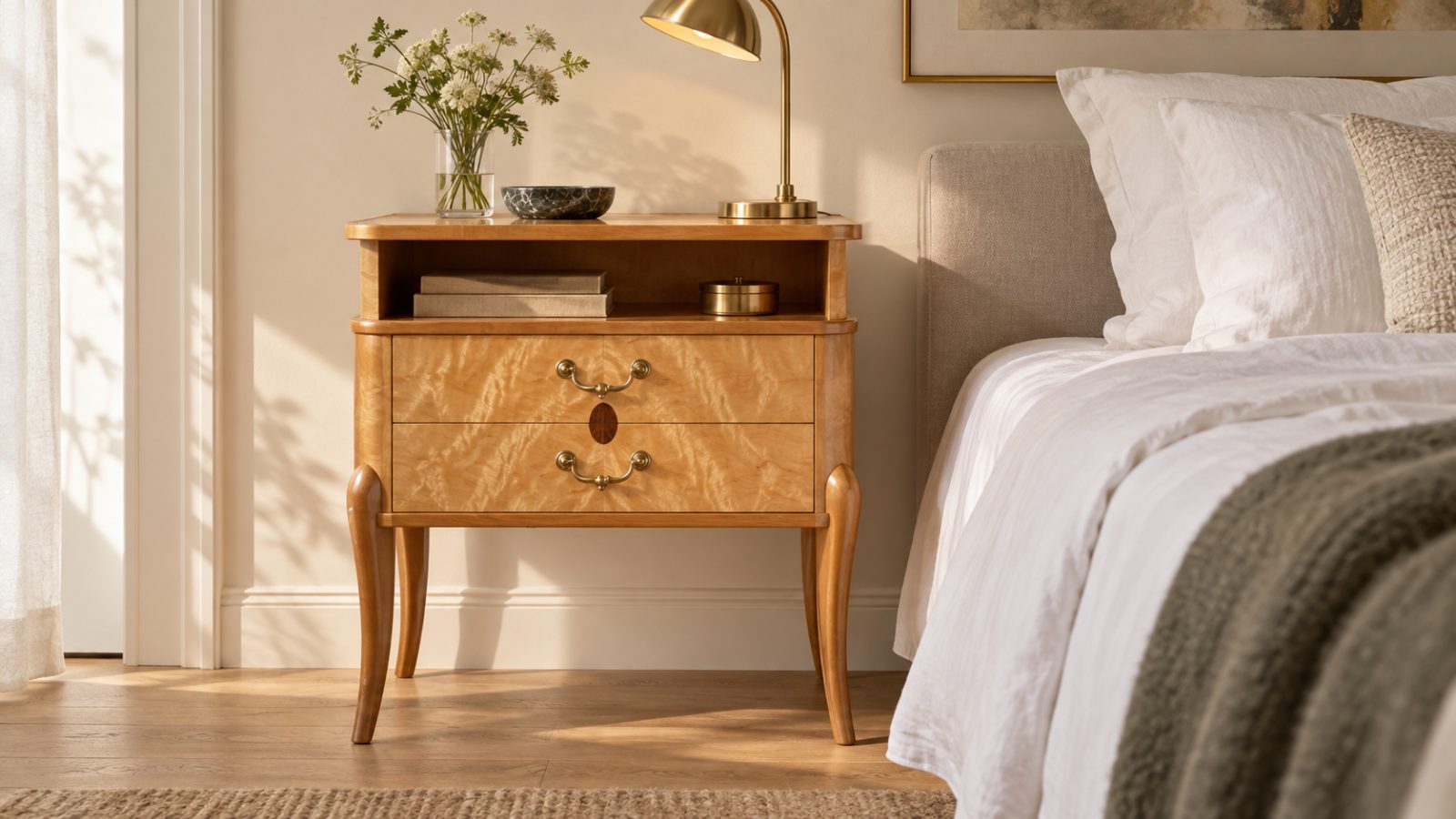
- Birch, pale and often flamed, is the Swedish bedside table of the 1920s to 1940s, in Swedish Grace and Swedish Modern. Robust, easy to lacquer, beautiful untreated if the veneer is intact.
- Mahogany, reddish brown and heavy, stands for the better pieces of the 1930s, Empire and Art Deco. Mahogany bedside tables often have a cracked polish and gain from a new finish.
- Oak, yellowish brown with distinct grain, belongs to the first half of the 20th century, to the brown-stained furniture of the 1950s and to today’s new furniture. The most robust of all, but heavy in expression.
- Walnut, dark brown with lively grain, is 1950s and the luxury segment of new furniture. Rare as a Swedish original.
- Teak, golden brown and oily, is 1950s and 1960s. Must be degreased before lacquering.
- Pine beneath a painted finish is the Gustavian original and the farmhouse bedside table. Almost always intended to be painted.
Solid wood, veneer or chipboard?
A bedside table "in oak" for little money is chipboard with a millimetre of oak veneer or foil. You can see it at the edges, where the grain ends abruptly, and you notice it when the drawer rattles after a year. A bedside table in solid or laminated wood with genuine veneer can be recognised by dovetailed drawers, a recessed back panel, grain that runs around the edges and a weight that surprises. Old bedside tables are almost always of the second kind. Knock on the side: solid wood sounds firm, chipboard dull. We explain the same criteria for chests of drawers in the chest of drawers guide.
Leave the wood visible or lacquer it?
Our rule: if the veneer is intact, beautiful and has character, such as flamed birch, mahogany with marquetry or walnut with grain, we leave it visible and renew the finish with new polish or matt lacquer. If the veneer is damaged, faded, stained or simply uninteresting, we lacquer. A lacquered bedside table in solid wood is still a wooden bedside table, with everything that goes with it, but with an expression that suits the bedroom. For this reason most of our bedside tables are lacquered, in black, white or grey; read more in black and white bedside tables. Examples: the black and white bedside tables in the Louis XVI style (€890 per pair) and the black and white bedside tables in the Gustavian Haupt style (€980 per pair). All pieces are in the category Chests of drawers and bedside tables.
Bedside tables in dark wood: how they work
Dark wood, mahogany, walnut or dark-stained oak, gives a bedroom weight and warmth, but risks looking "old" against dark parquet and dark walls. It works best against pale walls and a pale floor, with white bed linen and a brass lamp. Avoid two different dark woods at the same bed. A dark bedside table paired with a black lacquered chest of drawers, on the other hand, gives a calm, unified picture. The right counterpart is black chest of drawers.
Caring for wooden bedside tables
Untreated or oiled wood does not tolerate water rings; use coasters or choose a lacquered finish. Polish, the classic finish of old furniture, is beautiful but sensitive to heat and alcohol; a knocked-over glass leaves marks. Modern lacquer withstands both. Wipe with a slightly damp cloth, never wet, and keep the table away from the radiator, which dries out the wood and can loosen the veneer.
Buying old wooden bedside tables: what to check
- Drawer: it should run easily, be dovetailed and have an undamaged base.
- Veneer: bubbles and loose edges can be glued; missing pieces must be replaced in the same wood.
- Stability: if the table wobbles, the glue joints are dry; that is repairable.
- Smell: mould does not go away, dust does.
- Fittings: brass can be restored; missing knobs we replace with period-appropriate ones.
All our bedside tables have already been restored, so you do not have to check any of this yourself. How we work is described in the process of a redesigned piece of furniture.
Frequently asked questions
Which wood is the most robust for a bedside table?
Oak, followed by birch. Mahogany and walnut are softer and scratch more easily, but with a lacquered finish they hold up just as well.
Can an oak bedside table be lacquered?
Yes, but the coarse grain of oak shows through the paint unless it is filled. If you want a smooth finish, choose birch or mahogany beneath the paint.
What is an old solid wood bedside table worth?
Unrestored roughly €50 to €300 at auction, often as a pair. Restored by us about €890 to €980 per pair, depending on the period and finish.