
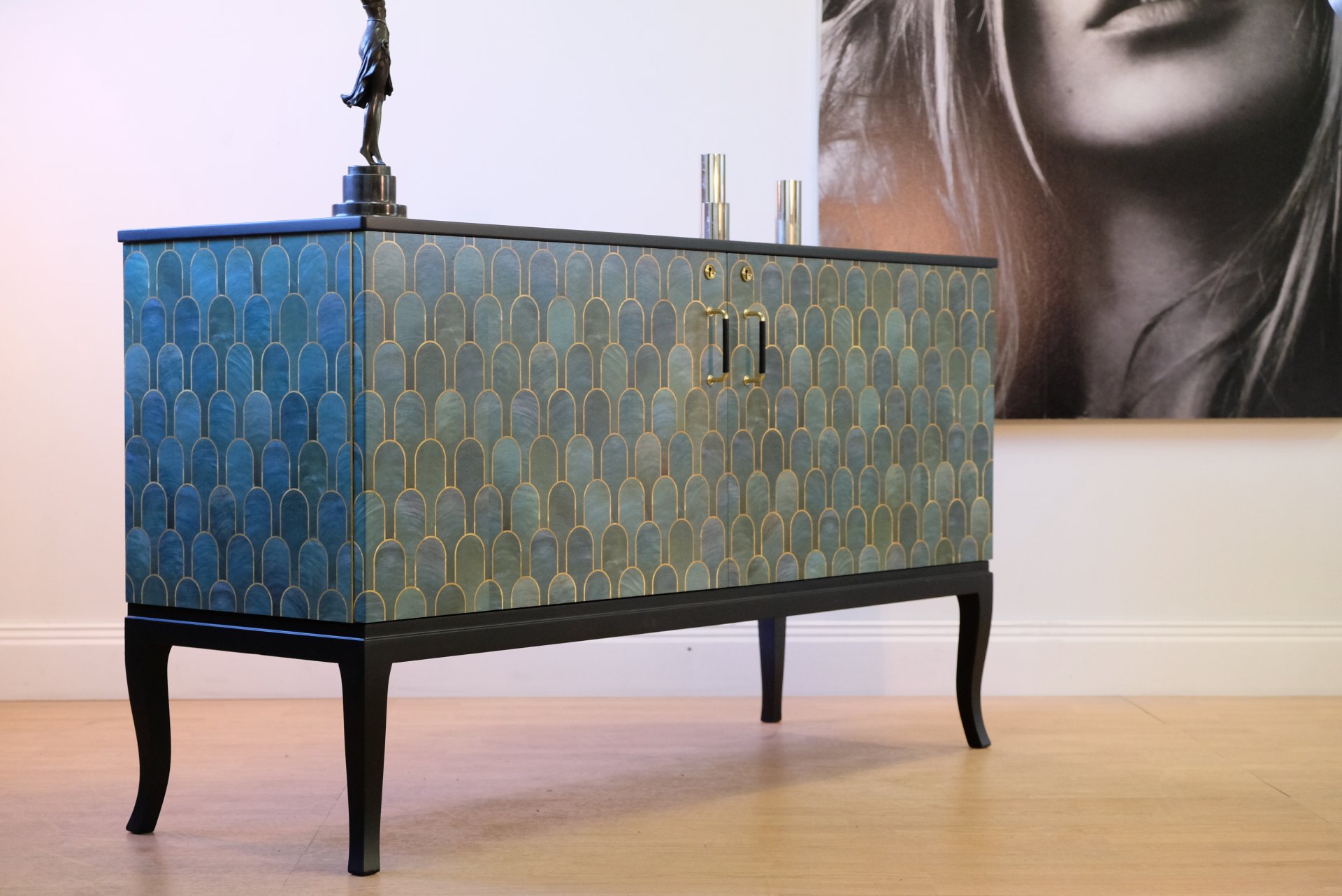
Living Room Sideboard – Placement, Height, Styling and TV
Sideboard in the living room: dimensions, placement, styling and television. With specific measurements in centimetres and examples of restored pieces.


A living room sideboard is storage, surface and eye-catcher in one. For it to do its job, four things matter: height and width in relation to the wall, a sensible position in the room, sideboard styling that does not overload it, and a plan for the television if one is to stand on it. This article gives specific dimensions and rules for each point. You will find an overview of all types and periods in the sideboard buying guide.
The right dimensions for the living room
Start with the wall, not the piece of furniture. A sideboard looks best when it takes up a clear part of the wall: if it stands alone, it should be no narrower than two thirds of the wall width. Leave at least 20 to 30 cm free between the piece and wall corners, windows or doors so that it does not look squeezed in.
| Dimension | Usual | Note |
|---|---|---|
| Height | 70 to 90 cm | comfortable when standing, fits under windows and pictures |
| Depth | 40 to 50 cm | enough for tableware and electronics, little loss of space |
| Width | 120 to 200 cm | depending on the wall; under 120 cm it looks more like a chest of drawers |
Our pieces fall within this range. The Art Deco sideboard from around 1930 is 142 cm wide, 81 cm high and 48 cm deep (€2,050). The Gustavian sideboard in matt black measures 185 × 81 × 44 cm (€2,400). Both are restored, one-of-a-kind pieces, which you will find in the Sideboards category.
Where the sideboard goes in the room
- Along the longest free wall. Here the piece looks calmest and creates order.
- Behind the sofa. As a divider towards the dining area: a depth of 40 to 50 cm is enough, and a lamp and a few books turn it into a console.
- Under the window. Watch the height of the windowsill and any radiators. Warm air under the piece harms wood and veneer in the long run.
- In the dining area. A sideboard beside the table holds tableware and cutlery; 80 to 100 cm between it and the table leaves room to push the chairs back.
- In the hallway or an alcove. A narrower piece works as a hallway cabinet with a mirror above it.
If a chest of drawers and a sideboard stand in the same room, they should match in colour or wood; you can read more about the difference between the two in the chest of drawers guide. For glass surfaces and lighting, a display cabinet is also worth considering.
Styling: three layers instead of many objects
The simplest rule is to think of the surface in three layers: a picture or mirror above, objects at different heights on top of the piece, and items inside. The picture may take up two thirds of the sideboard’s width and hangs about 15 to 25 cm above the top. Three to five things are enough on the sideboard: a lamp, a bowl or vase, a stack of books. Group odd numbers and vary the heights. A matt black sideboard copes particularly well with pale ceramics and wood; if the piece itself already has gold frames or brass fittings, add further metal accents sparingly. You can read more about the effect of black in Black sideboard, and the article Statement furniture shows an example of a piece that defines the room.
Sideboard and television
Many people look for a sideboard on which to stand the television. That works, but needs some forethought:
- Seated height. The centre of the screen should be at about eye level when seated, so roughly 100 to 110 cm above the floor. With an 80 cm high sideboard and a 55-inch set you get there almost automatically.
- Depth and stand. A set with two feet needs a surface that matches the width of the feet. Measure this beforehand.
- Cables. A sideboard with a back panel can be fitted with a cable outlet afterwards. Ask about it before the piece is painted.
- Ventilation. A compartment with electronics needs air. Open compartments or a back panel with an opening prevent heat build-up.
- Width. The sideboard should be wider than the television; this makes the combination look calm.
Alternatively, mount the television on the wall and use the sideboard beneath it purely as furniture. This looks calmer but requires tidy cable routing.
Which style suits your living room
A living room with modern furniture can take an old sideboard as a counterpoint. In period buildings with plasterwork, Gustavian forms look the most natural; in a room with clean lines, an Art Deco piece or a Scandinavian sideboard in matt black. For orientation: Scandinavian sideboard, Antique sideboard and Mid century sideboard. If the living room is also to house the home bar, the article Sideboard with drinks cabinet will help; as a large example it features the sideboard with drinks cabinet (200 × 82 × 50 cm, €2,300).
Think about the light, too. A matt piece absorbs light and looks calm in the evening, while a glossy one reflects lamps and windows. In rooms with a lot of daylight, matt black is the more forgiving choice, because fingerprints and reflections are less noticeable. Also allow space for the drawers: you need about 40 cm of clear floor in front of the piece so that doors and drawers can open fully.
How to buy from us
Plan B Design is a Swedish workshop. Every sideboard is a restored, one-of-a-kind piece, with prices between €1,400 and €2,400. Visit the Sideboards category, choose a piece and enquire without obligation. We clarify dimensions, condition and delivery with you; payment is by arrangement. Delivery within Germany is free. You can reach us under Contact, and the terms are set out under Right of withdrawal and returns.
Frequently asked questions
How high should a sideboard in the living room be?
70 to 90 cm is usual and comfortable. If a television is to stand on it, stay nearer 80 cm so that the screen stays at seated height.
How wide can a sideboard be?
As wide as the wall allows, as long as 20 to 30 cm remain free to corners and doors. Standing alone, it should fill at least two thirds of the wall.
Can I put a sideboard under the window?
Yes, if the windowsill is higher than the piece and there is no radiator directly beneath it.
How do I style a black sideboard?
With three to five objects at different heights: a lamp, pale ceramics, books. A picture or mirror above completes the composition.