
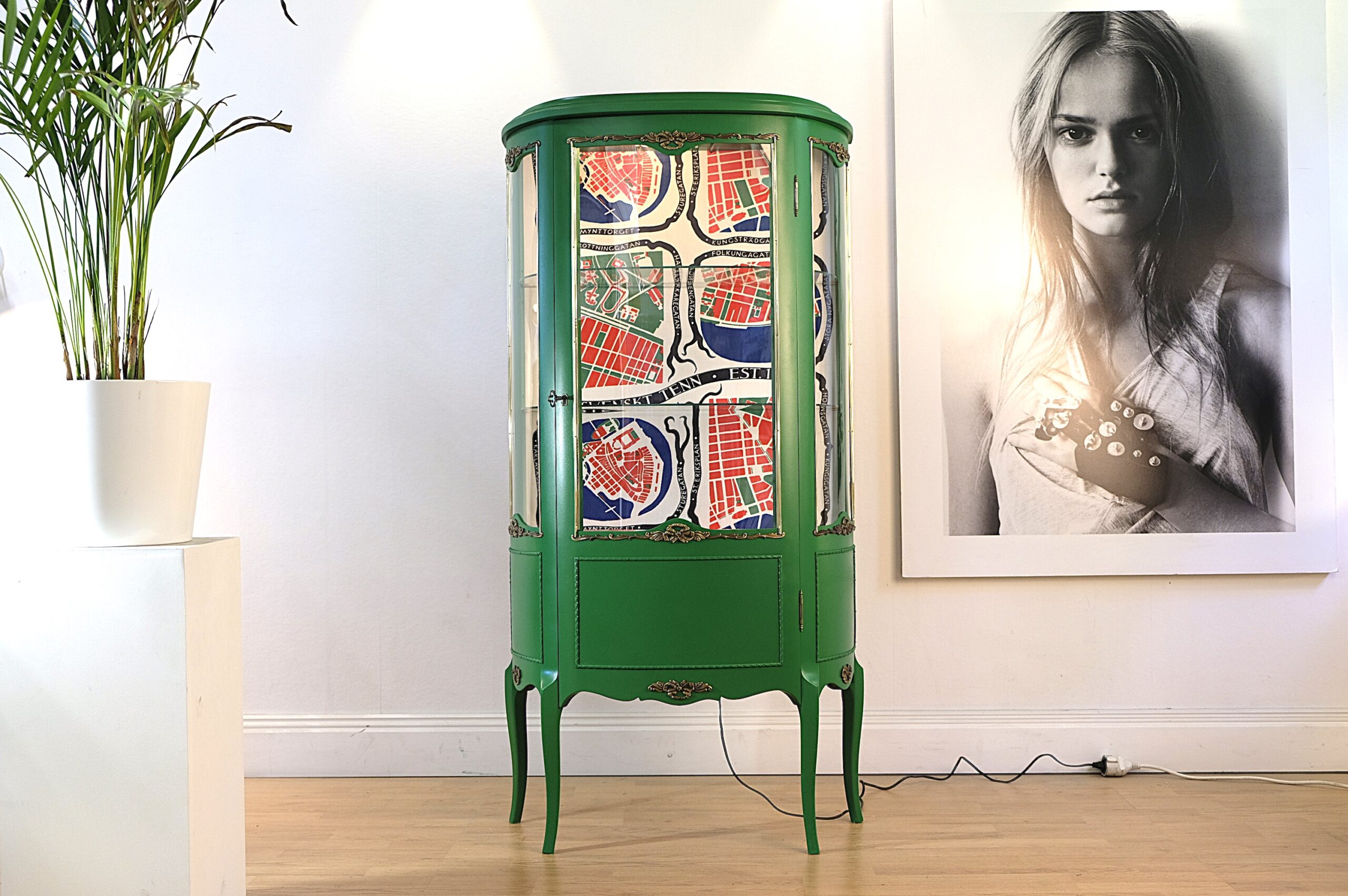
Josef Frank: Svenskt Tenn fabrics on restored furniture
Josef Frank and Svenskt Tenn: the history, well-known patterns such as Manhattan and Vegetable Tree, and how they look on restored Gustavian furniture.

Anyone searching for Josef Frank is usually looking for two things at once: the story behind the patterns, and an answer to the question of how to bring so much colour into a calm home. The short answer: the Josef Frank fabrics from Svenskt Tenn look best on a plain, clear furniture form, such as a Gustavian bench or the inside of a display cabinet. At Plan B Design, a Swedish workshop, we restore old furniture and, if you wish, upholster it in these fabrics. This article explains who Frank was, how to recognise his patterns and how to bring fabric and furniture together.
Who was Josef Frank?
Josef Frank (1885–1967) was an architect and designer. He was born in Austria and moved to Sweden in 1933, where he worked for Svenskt Tenn in Stockholm. The interiors company had been founded in 1924 by Estrid Ericson, and Frank worked with her for decades. In the 1940s he spent some time in New York, where he drew many of his textile patterns. Frank died in Stockholm in 1967.
Why do his fabrics still look fresh today? Because they never tried to follow a fashion. The patterns are rich in colour, botanical and full of imagination, yet they are not twee: flowers, leaves and fruit grow freely across the surface, without a strict grid. Then there is Frank’s attitude to living. A home should be made of things you like, not of a uniform style – an idea many people are looking for again today, preferring to let a room grow over the years rather than furnish it all at once.
The well-known patterns and how to recognise them
Svenskt Tenn still prints Frank’s patterns on linen today. Some of the best-known names:
- Manhattan – a pattern that Svenskt Tenn also offers in reinterpretations.
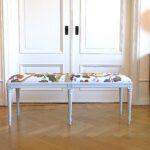
- Vegetable Tree – the pattern on our bench, printed on linen.
- Aralia – another botanical pattern from Frank’s repertoire.
- Celotocaulis – likewise a classic in the Svenskt Tenn range.
- Under Ekvatorn (Under the Equator) – the name points to distant, warm landscapes.
What they share is a mix of closeness to nature and invention. The plants are recognisable but never exact; the colours are strong but seldom loud. If you are unsure whether a fabric is a genuine Frank, the best course is to ask Svenskt Tenn for the name of the pattern. On our two current pieces, these are Vegetable Tree and Manhattan.
A strong fabric on a calm form
Upholstering an old piece of furniture in such an expressive fabric seems at first to be a contradiction. It works for a simple reason: the Gustavian form is straight, symmetrical and restrained. It gives the pattern a quiet stage, and the fabric gives the form a counterpart. Together they achieve more than either does alone. On an overloaded piece of furniture, the same fabric would look restless.
The rule we draw from this: let only one thing in the room be loud. If the pattern is strong, the furniture stays in a calm, single-colour finish. You can read more about the language of form and its roots in the article on Scandinavian country style.
Combining Frank’s patterns with black and grey
Plan B Design is known for black, grey and muted tones. This is no coincidence, because Frank’s colours benefit from a neutral setting. On a light grey or black surface the pattern stands free, without furniture and fabric competing for attention. As a rule of thumb:
- Light grey makes patterns look soft and Scandinavian, ideal for bright rooms and hallways.
- Black intensifies the colours of the fabric and gives the piece a graphic quality.
- Strong paint colours such as a deep green work if the fabric stays on the inside of the piece and the outside plays the leading role.
Choose the paint to match a colour in the pattern, or deliberately as a counterpoint to it. We are happy to help you choose the right shade. For general background on Scandinavian furniture and where it comes from, see Scandinavian vintage furniture and the comparison Swedish or Danish furniture.
As seat upholstery: the bench with Vegetable Tree
A fabric shows itself most clearly on a seat, because the surface is in your line of sight and invites use. Our grey Gustavian bench, upholstered in Josef Frank fabric is a Gustavian bench, probably from the 1960s. We restored it in classic light grey and re-upholstered the seat. It is covered in the Vegetable Tree pattern on linen (450 g) from Svenskt Tenn. The price is €1,350.
The grey bench is a good example of the principle “calm form, loud fabric”. In a hallway, at the dining table or at the foot of a bed, it carries the pattern without dominating the room.
On request, we also re-upholster chairs and seats. Write to us with the piece of furniture you have or are looking for, and we will work out together what is possible.
As interior wallpaper: the display cabinet with Manhattan
A second possibility is to use the fabric not on the outside but on the inside. Our green Gustavian display cabinet, Josef Frank motif is a classic Gustavian display cabinet, restored and painted in Emerald Green. The interior is covered with Svenskt Tenn’s reinterpretation of the Josef Frank pattern Manhattan (“Stockholm Est 1924”). Two adjustable glass shelves and interior lighting are included. The dimensions are 144 × 71 × 35 cm (H × W × D). The price is €2,300.
The advantage of this solution: the pattern forms the backdrop for whatever you display. Porcelain, glasses or books stand out against the colourful background, and from the outside the cabinet remains a calm green piece. How to arrange the contents is explained in the article Decorating a display cabinet; for a general overview of types and dimensions, see the display cabinet guide.
Care: linen in everyday life
Linen is robust and becomes softer with time. A few general tips that apply to most linen fabrics – for a specific piece, please ask us beforehand:
- Remove dust regularly with a soft brush or a vacuum cleaner on a low setting.
- Blot stains immediately with an absorbent cloth; do not rub.
- Avoid direct sunlight over the long term so that the colours do not fade.
- Upholstered seats can usually not be machine-washed; if soiled, professional cleaning is the safer route.
Linen shows creases and signs of use. That is part of its character, and with a pattern like Frank’s it is hardly noticeable.
How to buy from us
All pieces in the category All pieces are restored one-of-a-kind pieces. You enquire without obligation, we clarify condition, dimensions and delivery with you, and payment is made by arrangement. Shipping within Germany is free. You can reach us on the Contact page, and the terms can be found under Right of withdrawal and returns.
Frequently asked questions
Are the fabrics genuine Josef Frank fabrics?
The fabrics come from Svenskt Tenn, the company that still prints Frank’s patterns on linen today. The display cabinet features a reinterpretation of the Manhattan pattern.
Can I have my own bench or chair upholstered in a Frank fabric?
We discuss this on request. Write to us via the contact form with the piece of furniture and the pattern you have in mind.
Does such a colourful pattern suit black furniture?
Yes, black and grey give the fabric something to hold on to and make the colours stand out more strongly. The key is that only one element in the room is loud.
Is linen suitable for seats?
A 450 g linen is a sturdy upholstery fabric. Like any linen, it creases a little and becomes softer with time. Do ask us how best to care for the upholstery.