
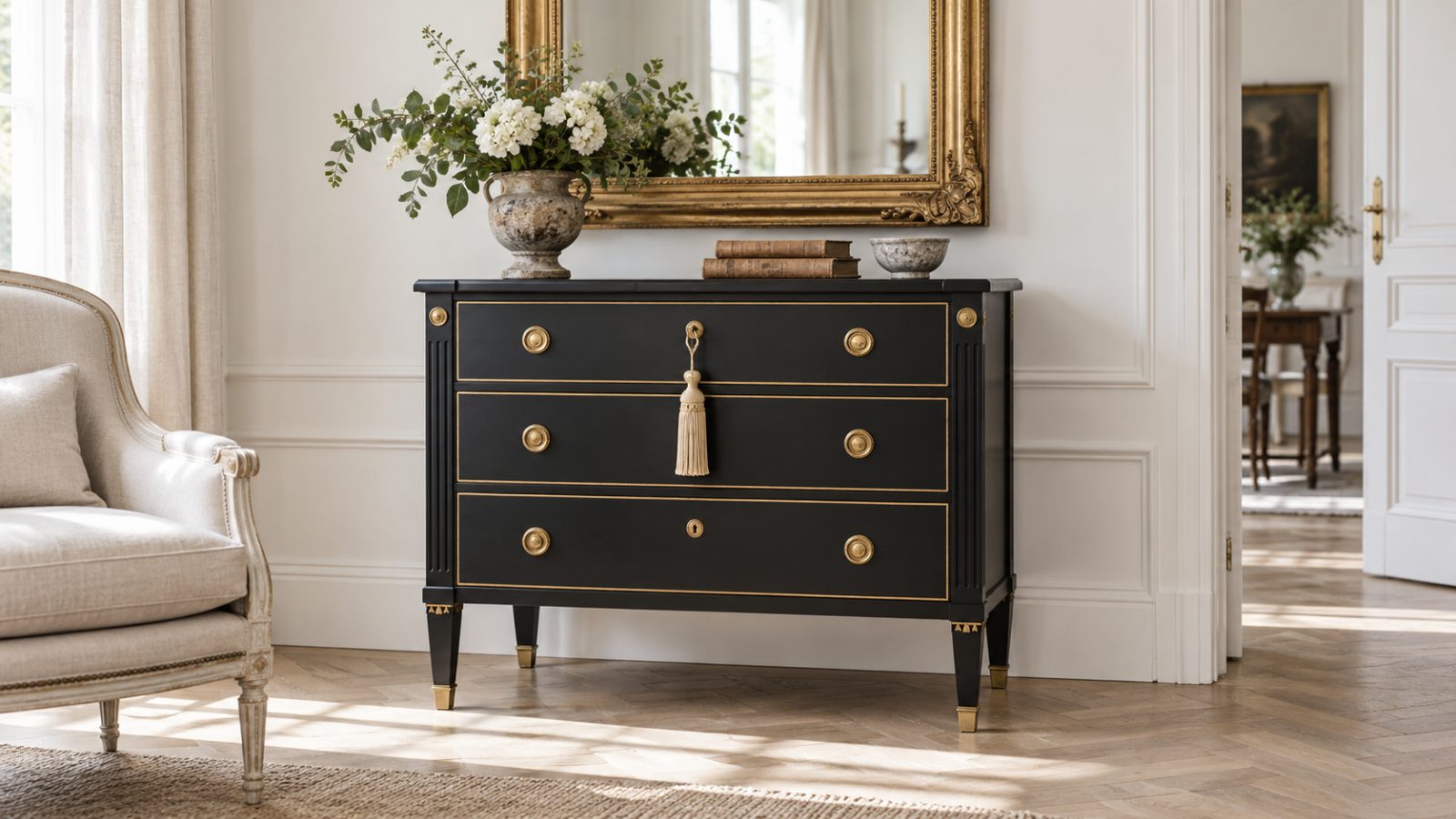
Chest of Drawers: The Guide to Dimensions, Wood, Colour and Style
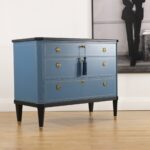
After the bed, the chest of drawers is the piece of furniture most often bought wrongly. Too narrow for the hallway, too low for the bedroom, in a colour that fights with the wall. This guide shows what really matters in a chest of drawers: dimensions and proportions, number of drawers, type of wood, colour, style and period, and the difference between a new chest of drawers in chipboard and a restored chest of drawers in solid wood. At Plan B Design, a Swedish workshop, we have restored and relacquered many chests of drawers from the 1920s to the 1950s. With no other piece of furniture does an old original beat a new one so clearly.
The dimensions: narrow, small, tall or large?
Start with the space, not with the chest of drawers. Measure the width of the wall, the depth you can spare and the height of whatever is to hang above. Then choose the type:
- Narrow chest of drawers, 30 to 45 cm deep and 60 to 90 cm wide, for hallways, niches and tight bedrooms. Everything about it in our article on the narrow chest of drawers for the hallway.
- Small or low chest of drawers, under 80 cm tall, as a bedside table, under the window or in the children’s room. See Small chest of drawers.
- Tall chest of drawers, 100 to 130 cm, with five to seven drawers for clothing. See Chest of drawers in the bedroom.
- Large chest of drawers, 120 cm wide or more, often with two rows of drawers. It replaces a cabinet or a sideboard.
Rule of thumb: the interior height of a drawer should be at least 12 cm for folded jumpers and 8 cm for underwear and socks. Old chests of drawers often have deeper drawers than new ones – one more reason to choose an original.
The rooms: hallway, bedroom, living room
In the hallway the chest of drawers must be narrow and knock-resistant and have a drawer for keys and gloves. A dark or black chest of drawers looks best here because it does not show dirt. In the bedroom the chest of drawers is primarily storage: tall, with many drawers, and as a pair it can also serve as bedside tables – read more in the bedside table guide. In the living room it is a statement, a solitary piece under a picture, and may be more decorative. A Rococo chest of drawers or an Art Deco-style chest of drawers in black lacquer suits it there; for an example of the effect of single pieces, see our article on statement furniture.
Woods: oak, birch, mahogany, pine
“Wood” means something different depending on the period. Pine under a painted finish is the Gustavian original and the Swedish farmhouse chest of drawers of the 19th century. Birch, often flamed, stands for Swedish Grace and the 1920s to 1940s. Mahogany belongs to Empire, Art Deco and the better 1930s. Oak characterises the first half of the 20th century and today’s new furniture: robust, but heavy in expression. Teak is typical of the 1950s and 1960s. What matters is less the type of wood than what lies beneath: solid wood or blockboard in the carcass and real veneer on the fronts mean quality, chipboard under veneer does not. The same criteria apply to any good piece of furniture; how we proceed with restoration is described in Why restore instead of buying new.
Colour: white, black, grey or wood?
The white chest of drawers is the most common search and the one we most often advise against: white shows signs of wear, yellows and makes an old piece of furniture look flat. Pearl grey is the Gustavian original and works in light rooms. Black is our signature: it lets the form speak, hides signs of wear and ties the chest of drawers into modern interiors. Untreated or oiled wood is right when the grain is beautiful and the room is calm. You can read the detailed reasoning in Black chest of drawers and Chest of drawers in white, blue and colourful.
Style and period: Gustavian, Rococo, Swedish Grace, Art Deco
The form decides more than the colour how a chest of drawers looks. Gustavian chests of drawers are straight and symmetrical, with fluted legs and three drawers – the most timeless form, covered in detail in Gustavian chests of drawers. Rococo chests of drawers have a curved front and legs and look dramatic in black. Swedish Grace chests of drawers of the 1920s are tall and narrow, often with marquetry; the background is explained in What is Swedish Grace?. Art Deco chests of drawers have rounded corners, plinths and handleless drawers, see Art Deco furniture. Anyone who prefers something older or plainer will find ideas in Vintage chest of drawers. Currently available are, for example, the off-black chest of drawers in Rococo style (€1,100), the black-and-white chest of drawers with gold in the Haupt style (€980) and the Gustavian chest of drawers in petrol blue with gold (€980). You will find them all in the Chests of drawers and bedside tables category.
Old chest of drawers or new: why the original wins
A new chest of drawers for a few hundred euros is almost always made of chipboard with foil or thin veneer. The drawers run on metal runners that rattle after a few years, and the resale value is zero the day after purchase. An old chest of drawers from the first half of the 20th century is built of solid wood, has dovetailed drawers that run on wooden runners, and will last another hundred years. Unrestored, it sells at auction for roughly between €150 and €700. Restored and relacquered by us, with a new finish, adjusted drawers and refurbished or new fittings, it currently costs about €980 to €1,100. The difference from a new chest of drawers in the same price range: the old one is a one-of-a-kind piece, more hard-wearing and can be redesigned again. More on this in Modernised chest of drawers and Redesigned furniture.
What to look for before buying an old chest of drawers
- The drawers. Pull them all out. They should run easily, be dovetailed at the corners and have an intact base. Sticking drawers can be adjusted, cracked bases replaced.
- The carcass. Press on a corner. If the chest of drawers wobbles, the glue joints are dry – a simple but necessary repair.
- The veneer. Bubbles and loose edges can be reglued; missing pieces must be replaced in the same wood.
- The back. A recessed back panel indicates quality, nailed-on hardboard the later half of the century.
- The smell. Mould in the drawers does not go away. Old wood and dust do.
How to buy from us
All the pieces you see in the Chests of drawers and bedside tables category are restored and available immediately. You enquire without obligation, we clarify dimensions, condition and delivery with you, and payment is made by arrangement. We quote the delivery cost on request. You can reach us via Contact, and the terms of return are set out under Right of withdrawal and returns. If you have a bedroom with a divan bed, it is worth a look at our bedside tables: a small chest of drawers is often the best solution there.
Frequently asked questions
What height should a chest of drawers be?
75 to 90 cm is comfortable when standing and fits under windows and pictures. From 100 cm we speak of a tall chest of drawers for storage, under 60 cm of a bedside table.
How many drawers do I need?
Three wide drawers are enough for one person’s folded clothing. Six drawers in two rows are enough for two people. More than seven drawers usually become too small to be practical.
Can I paint an old chest of drawers myself?
Yes, if it has already been painted: sand, prime, two coats of paint. Veneered chests of drawers demand more preparation, because the veneer must be intact and the surface degreased. An even, hard finish is achieved only with a spray gun.