
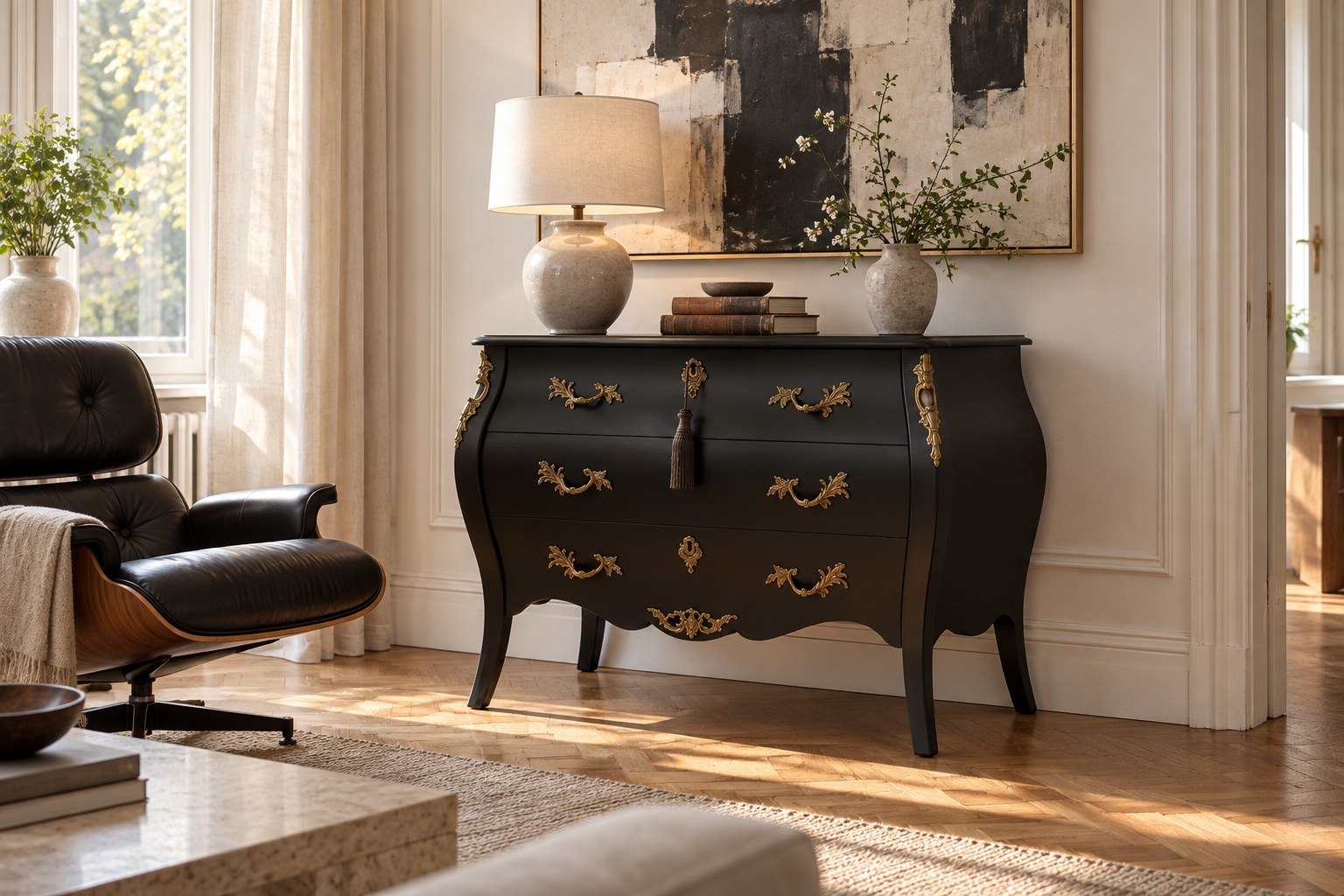
Vintage Chest of Drawers – Antique, Mid-Century or Swedish Grace?

A vintage chest of drawers is a piece of furniture with a history, but "vintage" is a broad term. It covers Biedermeier pieces just as much as the slender chest of drawers of the 1950s. Anyone looking for an antique chest of drawers should know how the periods differ, how to recognise quality and what to look out for when buying an old chest of drawers. This article gives an overview of the periods we restore most often in our Swedish workshop – from the Gustavian style to Swedish Grace and Swedish Modern – and describes what to look for when buying. The chest of drawers guide offers the full overview.
Antique, vintage, retro: what means what?
Furniture that is at least 100 years old counts as antique. Vintage describes pieces from earlier decades, usually from an age of around 20 to 30 years, and retro the style of the 1950s to 1970s. In practice the period matters more than the label, because it tells you something about construction, wood and form. A chest of drawers from the first half of the 20th century is almost always built of solid wood and is among the best purchases one can make for a home. You will find a comparison of Swedish and Danish furniture in Swedish or Danish furniture.
The periods at a glance
- Gustavian (late 18th century and its successors): straight, symmetrical, fluted legs, usually pine beneath a painted finish. The Haupt variant is tall enough to serve as a bedside table. See Gustavian chests of drawers.
- Rococo and Louis XVI: Rococo with a curved front and curved legs, Louis XVI as the straight, stricter French forerunner of the Gustavian.
- Swedish Grace (1920s to 1930s): tall, slender, often in birch or mahogany with marquetry. More in What is Swedish Grace? and Swedish Grace furniture.
- Art Deco (1920s to 1940s): rounded corners, plinths, handleless drawers, often mahogany. See Art Deco furniture.
- Swedish Modern and the 1950s: smooth fronts, slender legs, teak or walnut. The kinship is explained in mid-century furniture.
Antique wooden chest of drawers: what does each wood tell you?
Pine beneath a painted surface is the Gustavian original and the rustic furniture of the 19th century. Birch, often flamed, is Swedish Grace, 1920s to 1940s. Mahogany stands for Empire, Art Deco and the better pieces of the 1930s. Oak comes from the first half of the century and from today’s new furniture. Teak belongs to the 1950s and 1960s. For details of the Scandinavian tradition, see Scandinavian vintage furniture. An antique wooden chest of drawers is good when the carcase is made of solid or laminated wood and the fronts carry genuine veneer; chipboard beneath veneer is not quality.
Mid-century chest of drawers: what is different?
The mid-century chest of drawers stands on slender, often splayed legs, has smooth fronts without carving and usually teak or walnut as veneer. The proportions are low and long, 100 to 160 cm wide and 60 to 75 cm high. It suits pale walls and natural materials. If the style interests you, you will find more in mid-century furniture. As for colour: if the teak veneer is beautiful and intact, we leave it as it is; if it is damaged, it is painted, although teak must be degreased first.
Buying an old chest of drawers: what to look out for
- Drawers: pull them all out. They should run easily, be dovetailed at the corners and have an undamaged base.
- Stability: press on one corner. If it wobbles, the glue joints are dry, which can be repaired.
- Veneer: bubbles and loose edges can be glued; missing pieces must be replaced in the same wood.
- Back panel: a recessed panel is a sign of quality; nailed-on hardboard dates from the later half of the century.
- Smell: mould in the drawers stays, old dust does not.
Anyone who wants to buy an old chest of drawers has three routes: flea market and auction (inexpensive, but restoration is needed), the antiques trade (checked, often expensive) or a chest of drawers that has already been restored. The third route spares you the risk, and the work is done. Why this is worthwhile is explained in why restore instead of buying new.
Restored vintage chests of drawers at Plan B Design
We restore chests of drawers from the 1920s to the 1950s: adjusting drawers, repairing veneer, restoring fittings and relacquering, usually in black, white or petrol with gold or brass. Examples are the off-black chest of drawers in the Rococo style (€1,100), the black and white chest of drawers with gold in the Haupt style (€980) and the Gustavian chest of drawers in petrol blue with gold (€980). You will find them all in the category Chests of drawers and bedside tables. What the difference between restoration and redesign looks like is described in the difference between furniture restoration and redesign.
Bringing a vintage chest of drawers into your interior
A vintage chest of drawers works best when it is not surrounded by furniture of the same age but set against a contrast: a Gustavian chest of drawers in black next to a modern sofa, a Swedish Grace chest of drawers beneath a contemporary picture. The result is not a museum but a home with character. If you would like to explore the style further, you will find inspiration in Scandinavian country style. The principle of redesign is described in redesigned furniture.
Frequently asked questions
How do I recognise a genuine antique chest of drawers?
By hand-cut dovetailed drawers with irregular dovetails, plane marks on the back, a recessed back panel and a patina of use on the edges. An exact dating, however, usually needs a specialist.
Is a vintage chest of drawers better than a new one?
At the same price, almost always: solid wood instead of chipboard, a one-of-a-kind piece instead of a production run, and it can be redesigned again. A new one has the advantage only in dimensions and delivery time.
Is a second-hand chest of drawers worth restoring yourself?
If the surface has already been painted and the substance is sound, yes. Veneered pieces, sticking drawers and problems with smell involve more work than most people expect.