
Mid-Century Furniture: Swedish or Danish, Hallmarks, Prices and the Black Variant


Mid Century Modern is the most sought-after vintage era of all: furniture from the 1950s and 1960s with splayed legs, teak veneer and drop-down fronts. In Germany it is associated almost exclusively with Denmark. Yet in the same years Sweden built furniture that is just as good and considerably rarer, because it was never exported in large quantities. In this article we explain what defines mid-century furniture, how Swedish and Danish pieces differ, which types of furniture are typical and how a black-lacquered cabinet from the 1960s fits into a home today. You will find the place of this era among the other styles in the guide Scandinavian vintage furniture.
What Mid Century Modern means
The term describes the design of the mid-century, roughly 1945 to 1970. In Scandinavia, this was the time when the soft modernism of the 1930s, so-called Swedish Modern, combined with new materials: teak and rosewood from Asia, plywood, tubular steel, plastic. Forms became lighter and more geometric, and the furniture stood on slender, often splayed legs. At the same time the craftsmanship remained: dovetailed drawers, solid frames, veneer on wood. That is why these pieces are still intact sixty years later.
Hallmarks of mid-century furniture
- Splayed or tapering legs that lift the carcass off the floor. The piece looks as if it is floating.
- Teak and rosewood with visible, warm grain, oiled or matt lacquered. On Swedish pieces also birch and elm.
- Flaps and pull-outs: bureau flaps, bar compartments with light, pull-out shelves, revolving bases.
- Finger rails instead of handles, often routed from the wood, or small brass knobs.
- Organic forms in armchairs and tables: kidney shapes, curved backs, boomerangs.
Swedish or Danish mid century?
Danish furniture of this period is more sculptural: visible wood joints, carved backs, designers with names such as Wegner, Juhl and Mogensen. It was exported in vast quantities to Germany and the USA and is now collectors’ stock. Swedish furniture of the same years is more matter-of-fact and more homely, often from makers such as Bodafors, Tibro or Ulferts, and mostly anonymous. It therefore costs a fraction of the price, at the same build quality. If you are looking for a mid-century sideboard and do not need a museum piece, you are better off with Swedish goods. You will find the detailed comparison in the article Swedish or Danish furniture?.
The types of furniture: sideboard, chest of drawers, drinks cabinet
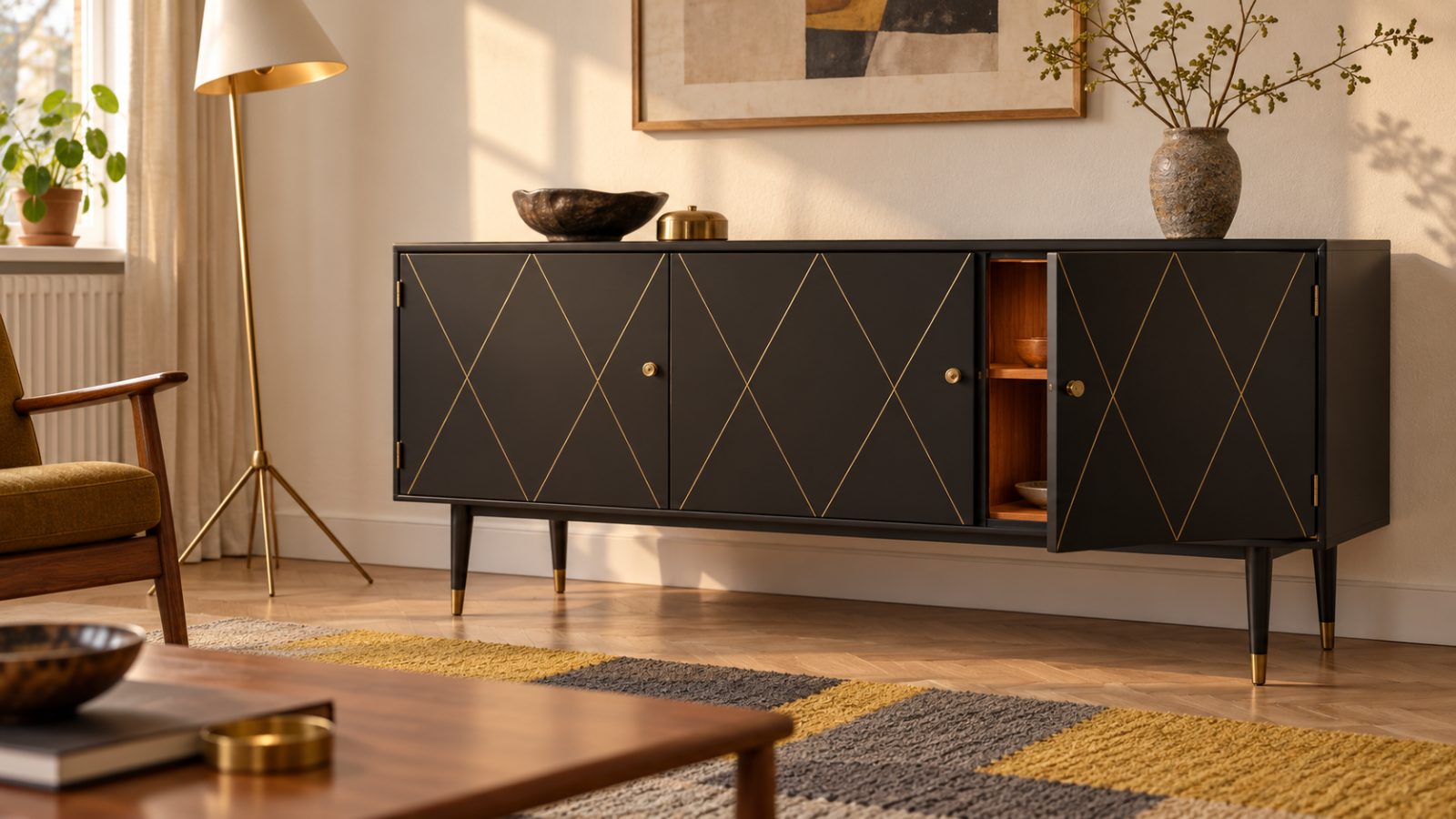
The mid-century sideboard is the piece of the era: long, low, on legs, with sliding doors or flaps. With us in the Sideboards category. The mid-century-style chest of drawers with four to six drawers and finger rails, see Chests of drawers and bedside tables. The drinks cabinet, often with a drop-down front, interior mirror and lighting: for example the drinks cabinet with gold diamonds from the 1960s and the black and white vintage drinks cabinet of the 1960s. Everything about drinks cabinets of this period is in the article Retro drinks cabinet of the 50s and 60s. Then there are bedside tables, armchairs with wooden frames and the classic string shelves.
Mid century today: keep the teak or lacquer it black?
A teak piece with an intact surface deserves to stay teak. Many pieces, however, have veneer damage or water marks, or have already been badly reworked once. In that case redesign is the better route: a matt or glossy black that emphasises the form and takes the piece out of the retro corner, often with brass, gold leaf or a hand-painted pattern. A black-lacquered mid-century sideboard does not read as “sixties” in a room today, but as a design object. Why this works is explained in the article Black drinks cabinet, and how the piece fits into a modern room in Furnishing with a modern drinks cabinet.
Prices and what to look for when buying
Danish design classics: €2,000 to €20,000 and more. Anonymous Swedish mid-century furniture, unrestored: €200 to €900. Restored and redesigned by us: as a rule €900 to €3,850, including delivery within Germany. When buying, always check veneer edges for lifting, drawer runners for wear and, on drinks cabinets, the electrics, which after sixty years should be completely renewed. All available pieces under All pieces for sale.
Frequently asked questions
Is mid century the same as retro?
Retro is the collective term for anything that looks like the past, including newly made pieces. Mid century refers to the actual era of 1945 to 1970 and its originals.
How do I recognise genuine teak?
By its golden-brown to dark brown colour with straight, partly black-streaked grain, its slightly oily feel and the typical smell when sanded. Veneered teak is normal and not a defect; what matters is the substrate beneath.
Do mid-century pieces go with Gustavian ones?
Yes, if both are finished in the same colour. In black lacquer, a sideboard from the 1960s and a Gustavian chest of drawers stand in the same room without difficulty. In natural wood and pearl grey side by side, by contrast, they look like two eras that do not know each other.