
Mid Century Sideboard – Teak, 1950s and 1960s, Features and Prices
What defines a mid century sideboard: teak, slim legs, flat fronts. With key features, examples from our workshop and prices.


A mid century sideboard dates from the 1950s and 1960s, is usually built from teak and stands on slim, slightly splayed legs. Its hallmark is the calm, flat front without ornament. This article describes the typical features, explains how to recognise a genuine sideboard from the 60s, how prices are formed and why a teak sideboard can also look good in black. You will find the basics on dimensions and construction in the sideboard buying guide.
What mid century means
The term describes furniture design of the middle of the century, roughly 1945 to 1970. After the war people wanted furniture that was light, affordable and adaptable, and they found it in a design language we now know as Scandinavian. Danish manufacturers worked teak on a large scale and exported it all over the world, but in Sweden, too, furniture was made in these years on the same principle. How the two countries differ is explained in the comparison Swedish or Danish furniture; the article Mid-century furniture gives an overview of the period.
Features of a sideboard from the 1950s and 1960s
- Teak, often as veneer: The core is blockboard or chipboard, with teak veneer on the visible surfaces. This is not a flaw but was usual at the time and is durable when well made.
- Slim legs: Usually four, slightly tapered and sometimes with brass feet. This makes the sideboard look light.
- Flat fronts: Doors and drawers are plain, often with finger recesses or small metal handles instead of applied decorative mouldings.
- Sliding doors and tambour doors: They save space because nothing projects into the room when opened.
- Interior: Adjustable shelves, drawers on wooden runners and a separate section for cutlery are typical.
- Proportions: Wide and low, often 150 to 200 cm wide and around 80 cm high.
Dimensions and examples
Mid century sideboards are built lower than their predecessors from the 1930s, because the legs visually lift the piece off the floor. Two examples from our workshop, both from around 1960:
| Piece | Dimensions (W x H x D) | Special feature | Price |
|---|---|---|---|
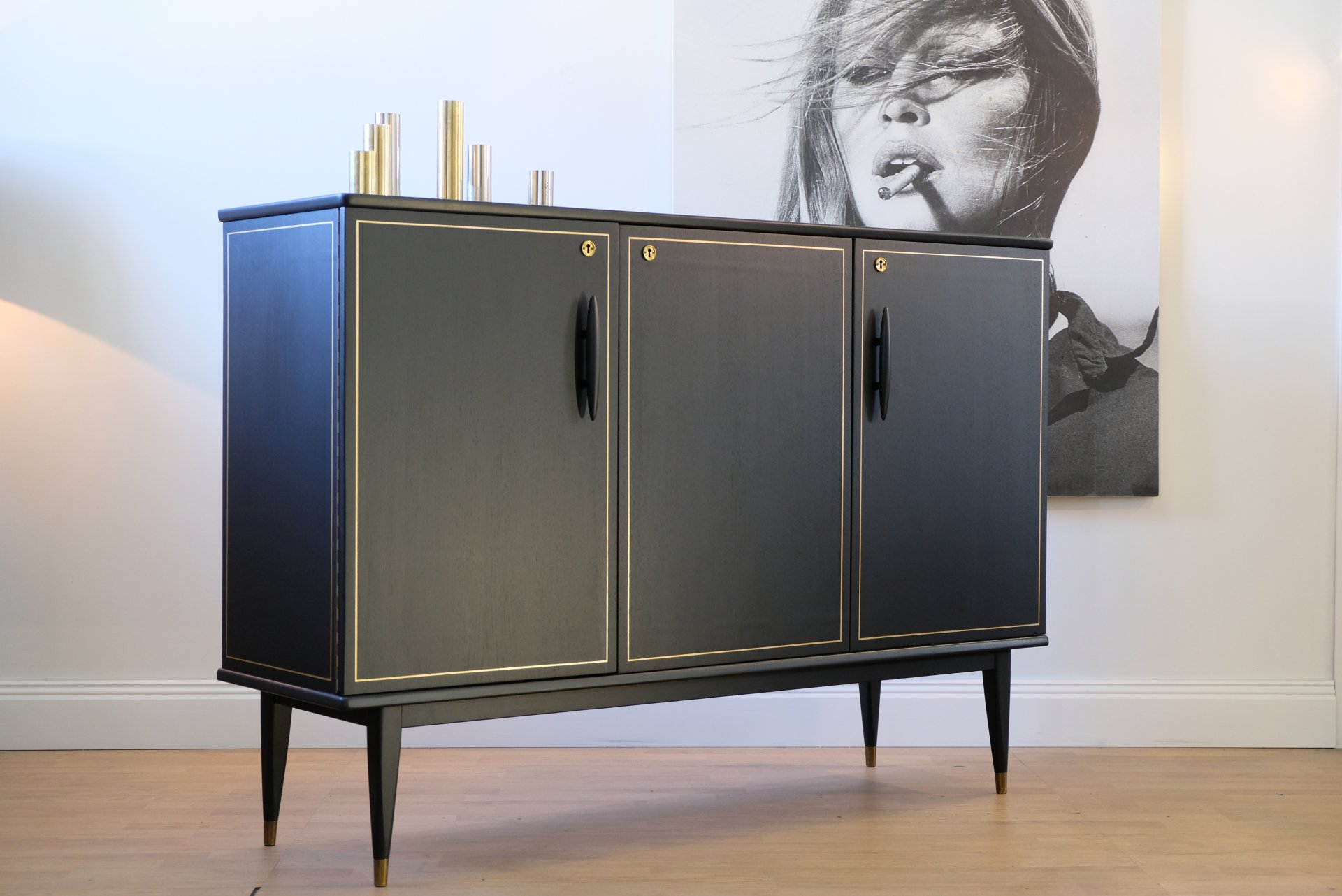
| Teak, black with gold frame | 152 x 106 x 43 cm | Teak, brass feet, drawers and shelves inside (sold) | €2,050 |
| Black with seagrass | 170 x 80 x 42.5 cm | Seagrass on doors and drawers, new glass top, handles by Buster and Punch (sold) | €1,400 |
Both have been sold; an identical piece can be sourced to order. At 106 cm high, the teak sideboard is strictly speaking a highboard, but it shows how much the forms of the period vary. The seagrass sideboard, by contrast, combines the mid century line with a material that was popular in the 1960s and is in demand again today.
Painting teak black: sensible or sacrilege?
Many collectors do not want to see their teak touched. That is understandable when the surface is intact. It is different if the veneer is stained, the colour has darkened unevenly or the piece gets lost among other furniture. In that case a matt black paint with gold or brass details is an honest solution: the piece remains original in construction and proportion and gains a finish that works in a modern living room. We choose pieces in sound condition, because paint cannot hide structural faults. You can read how black looks on sideboards in Black sideboard.
Prices: what a mid century sideboard costs
Prices vary widely. What counts is the maker, condition, size and whether the piece has been restored. A piece with a known name and original veneer fetches considerably more than an unnamed one, while a damaged one is cheaper and needs work. We cannot give binding market prices here. With us, restored sideboards from the 1960s range from €1,400 to €2,400. The price includes the restoration, the new finish, new fittings where needed and delivery within Germany. An example of the upper end is the Gustavian-style sideboard from around 1960 that was restored in matt black with brass fittings (190 x 90 x 45 cm, €2,400, sold). What distinguishes the price ranges from style to style is explained in Vintage and retro sideboards.
Furnishing with mid century today
A sideboard on legs needs air: leave space beneath and beside the piece so that its lightness shows. It sits well with neutral walls, oak parquet and linen fabrics. On top, ceramics, a table lamp with a slim base and a picture propped at an angle behind all work. If you mix the style with older pieces, you do well to limit the colours: a black mid century sideboard next to a Gustavian chair or an Art Deco display cabinet looks harmonious, as long as the materials are similarly matt. You will find ideas for placing it in the room in Living room sideboard.
Genuine or reproduction? What to look for
Mid century is so popular that there are many reproductions. These points help with the assessment:
- Labels and stamps: Maker’s plaques on the inside of the side or under the top are a good sign, although their absence is no proof against.
- Veneer edges: On originals they are cleanly glued; reproductions often have stuck-on plastic edging.
- Joints: Dovetailed drawers and wooden runners point to quality. Metal runners and staples point more to late mass production.
- Signs of use: Light patina on edges and legs is desirable. Artificial ageing that is too even is suspicious.
How to buy from us
Our sideboards are restored, one-of-a-kind pieces from a Swedish workshop. In the Sideboards category you can see the current pieces, such as the sideboard with drinks cabinet from around 1960 (200 x 82 x 50 cm, €2,300). You enquire without obligation, we clarify dimensions and delivery, and payment is by arrangement. Delivery within Germany is free. You can reach us via Contact, and the terms are set out under Right of withdrawal and returns.
Frequently asked questions
How do I recognise a sideboard from the 60s?
By the slim, often tapered legs, the flat fronts, the teak veneer and the lack of ornament. A maker’s label is helpful but not always present.
Is teak the only wood for mid century?
No. Teak dominates, especially in Danish furniture, but rosewood, oak, birch and walnut also occur.
Can I have a teak sideboard made darker?
It can be done, but it is an intervention. Where the veneer is intact, we recommend preserving the wood. For stained or damaged surfaces, a matt black paint is one option.
How tall is a mid century sideboard?
Usually around 80 cm, more for models on tall legs or with a superstructure. The teak sideboard in our example measures 106 cm.