
Antique Sideboard and Old Dresser – Periods, Condition, Prices
Antique sideboard or old dresser: periods, condition, what to look for when buying and what restored pieces from Plan B Design cost.


An antique sideboard is a low, wide piece of furniture for storing, serving and displaying, built in the first half of the 20th century or earlier. In the past it was more often called a dresser or serving table. This article explains how the two terms differ, which periods you are likely to come across, what condition an old piece should be in and how prices are made up. For an overview of all the types, see the sideboard buying guide.
Sideboard or dresser: a difference of period
A dresser was originally the piece in the dining room on which food was prepared and dished up before it went to the table. Older examples often have a superstructure with a shelf or glazed doors, tall feet and a heavy top. “Sideboard” is the more recent term, borrowed from English. It describes a flat, long piece without a superstructure, which stands not only in the dining room but also in the living room, the hallway or as a base for a television. In the trade the two words are now used almost interchangeably. Anyone looking for an old dresser usually means a piece 80 to 90 cm high, 40 to 50 cm deep and 130 to 200 cm wide.
What “antique” means
In the trade, a piece of furniture is traditionally considered antique if it is at least 100 years old. Strictly speaking, pieces from the 1930s fall just short, but they are often sold as antique too, particularly if they date from the interwar period and are properly crafted. Anything from about 1950 onwards is more likely to be described as vintage or retro; we have covered the mid-century period in the article on the mid century sideboard. For everyday use, the construction matters more than the label: solid wood in the carcass, veneer on the fronts, drawers running on wooden runners and a recessed back panel all point to quality.
The periods at a glance
| Period | Dates | Characteristics of a sideboard |
|---|---|---|
| Gustavian | late 18th century | straight, symmetrical form, fluted legs, restrained fittings; reproduced as a style well into the 20th century |
| Art Nouveau | around 1900 | curved lines, floral ornament, often glass or inlay |
| Art Deco | 1920s and 1930s | clear geometry, a plinth instead of tall legs, patterns, rounded edges |
| Swedish Grace / Swedish Modern | 1920s to 1940s | calm proportions, fine veneer, subtle details |
The Gustavian form is the longest-lived: it was copied over generations, so a “Gustavian” sideboard from the 1940s or 1960s echoes the style of the late 18th century without being that old. You can read more about the roots of this style in the article Scandinavian country style. For Art Deco, the details are in Art Deco furniture, and the particular features of sideboards are described in the article Art Deco sideboard.
Condition: what to look for in an old sideboard
An old piece of furniture may show signs of age, but the construction must be sound. Check these points before you decide:
- The carcass. Press against the side of the piece. If it wobbles, the glue joints have dried out; this can be put right, but it belongs in your calculation.
- The drawers. They should run smoothly, be dovetailed at the corners and have an intact base.
- The veneer. Bubbles and loose edges can be glued down. Missing pieces must be replaced in the same wood.
- The doors. They must close flush. Warped doors suggest damp in storage.
- The fittings. Original handles are a plus; missing ones can be reproduced in brass.
- The smell. A musty smell inside can usually be aired out, but mould cannot.
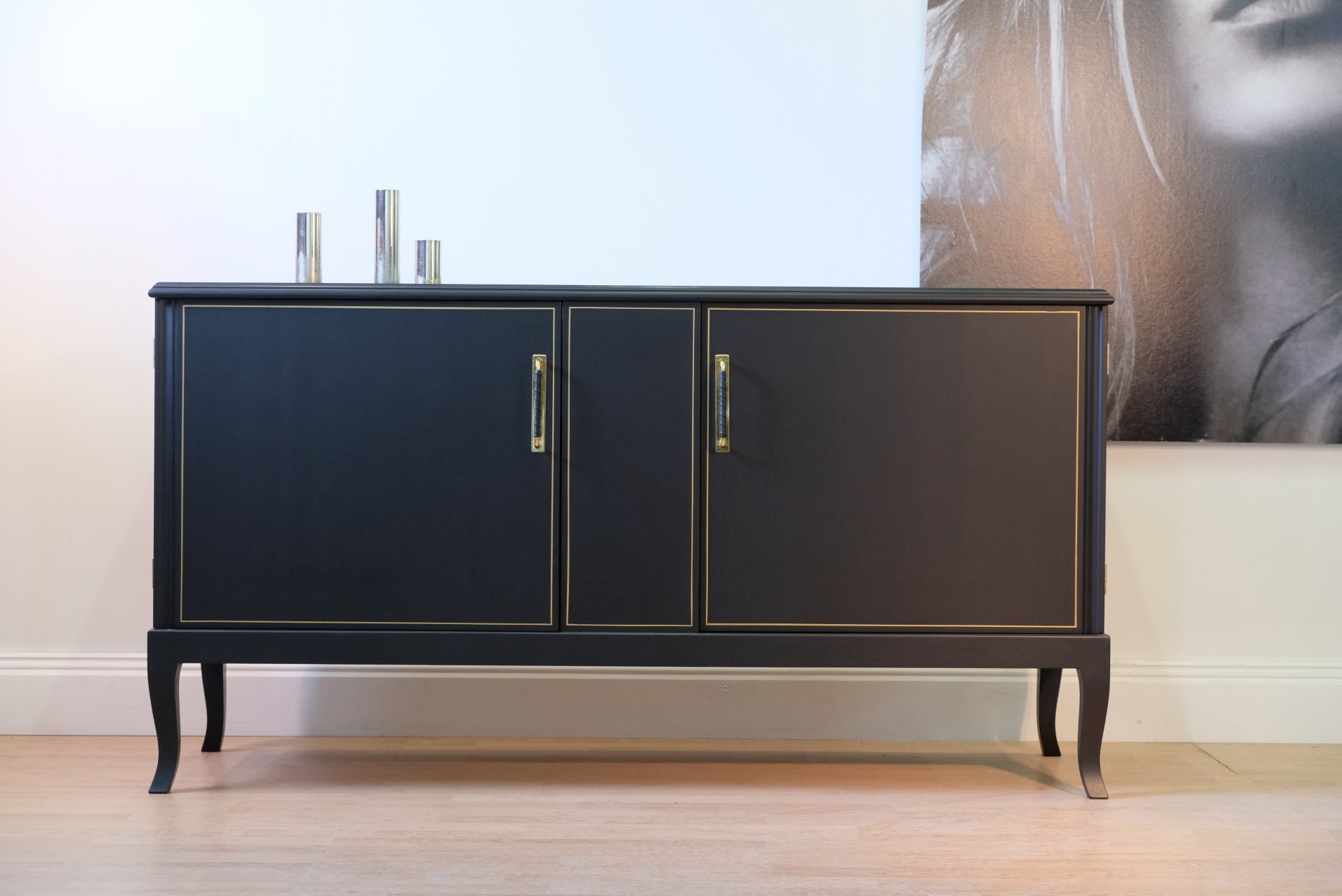
At Plan B Design, a Swedish workshop, all of these points are put right before painting. One example is the antique black sideboard with gold frame from around 1930: it was painted in matt black, given an interior in Farrow & Ball Railings and new handles in solid brass and black twisted natural leather. The piece is 145 cm wide, 85 cm high and 46 cm deep and has since been sold; a similar piece can be sourced to order.
Prices: what an antique sideboard costs
Reliable figures exist only for what we sell ourselves. Our restored sideboards range from €1,400 to €2,400. The antique sideboard from 1930 with a gold frame cost €1,600, the Art Deco sideboard from around 1930 with a green and blue pattern costs €2,050, and the Gustavian models are priced at €2,300 to €2,400. The price is determined above all by size, the effort involved in the restoration, the rarity of the form and the type of fittings. An unrestored piece is cheaper but demands time, a good restorer and patience. Allow for repairs, a new finish and fittings, and the total can quickly eat up the saving. You can read more about weighing this up in Why restore instead of buying new.
Painted black: why the dark finish suits old furniture
Many old sideboards have darkened veneer, uneven surfaces or earlier repairs. A matt black paint turns these into a calm, uniform surface on which the form can be seen, and it suits modern and classic rooms alike. In our workshop this results in variants in matt black, black with narrow gold frames, or graphic black and white. The article Black sideboard describes how black looks and which level of sheen suits. One Gustavian variant that is currently available is the matt black sideboard with brass fittings (185 × 44 × 81 cm, €2,400). Because each piece is painted by us, these are painted sideboards that have been given a second life as upcycled furniture.
How to buy from us
You will find all our sideboards in the Sideboards category. Every piece is a restored, one-of-a-kind piece. You enquire without obligation, we clarify dimensions, condition and delivery with you, and payment is by arrangement. Delivery within Germany is free. You can reach us via Contact; the terms are set out under Right of withdrawal and returns. If the piece you want has already been sold, a similar one can be sourced to order.
Frequently asked questions
How old does a sideboard have to be to count as antique?
Traditionally 100 years. Pieces from the 1920s and 1930s are nevertheless often described as antique in the trade, while more recent ones are called vintage.
Is a dresser the same as a sideboard?
In everyday usage today, largely yes. Historically the dresser often had a superstructure, whereas the sideboard is flat and long.
Is an antique sideboard worth choosing over a new one?
Yes, if it is solidly built and professionally restored. It is a one-of-a-kind piece, will last for decades to come and can be redesigned again.
Can I order an old sideboard in the colour I want?
For a piece sourced to order, we will help you find the right shade for your interior. Please get in touch via the contact page.