
Vintage and Retro Sideboards – How to Recognise Good Old Pieces
Vintage is the real thing, retro often only in style: how to recognise a good old sideboard, what can go wrong when buying and which pieces we have restored.


A vintage sideboard is a piece that has genuinely been used, at least two to three decades old, whereas a retro sideboard may be new and merely look the part. Anyone looking for a good old piece should therefore pay attention to construction, material and condition rather than to the description in the listing. This article explains the terms, names the features by which you can recognise real quality and shows what can go wrong when buying a second-hand sideboard. General notes on dimensions and styles are in the sideboard buying guide.
Vintage, retro, antique: the terms
The words are not used consistently in the trade. A workable rule of thumb:
| Term | Meaning | Typical period |
|---|---|---|
| Antique | At least 100 years old | Before about 1920 |
| Vintage | A genuine, used piece of furniture from an earlier period, usually 30 to 100 years old | 1920s to 1990s |
| Retro | Design in the style of an earlier time, original or brand new | 1950s to 1970s as the model |
Anyone searching for a “retro sideboard” therefore often gets new goods with a teak look. Anyone searching for a “vintage sideboard” finds a mixed bag of listings. You recognise a genuinely old piece not by the label but by the construction. Antique dressers are covered in the article Antique sideboard, and the middle of the century in the post Mid century sideboard.
How to recognise good old pieces
- Dovetailed drawers: The corners are joined with visible dovetails. Stapled or glued corners point to later mass production.
- Wooden runners: Drawers run on wooden runners, not metal rails. The wood should be smooth and lightly waxed.
- Recessed back panel: It sits in a groove. Hardboard nailed on points to the later half of the century.
- Solid plinths and legs: They are tenoned or screwed in place, not glued on.
- Weight: An old solid wood sideboard is heavy. A very light piece usually has a hollow chipboard construction.
- Marks: Old pieces bear the marks of their time. They are not a flaw as long as the construction and fittings are in order.
Examples from our workshop
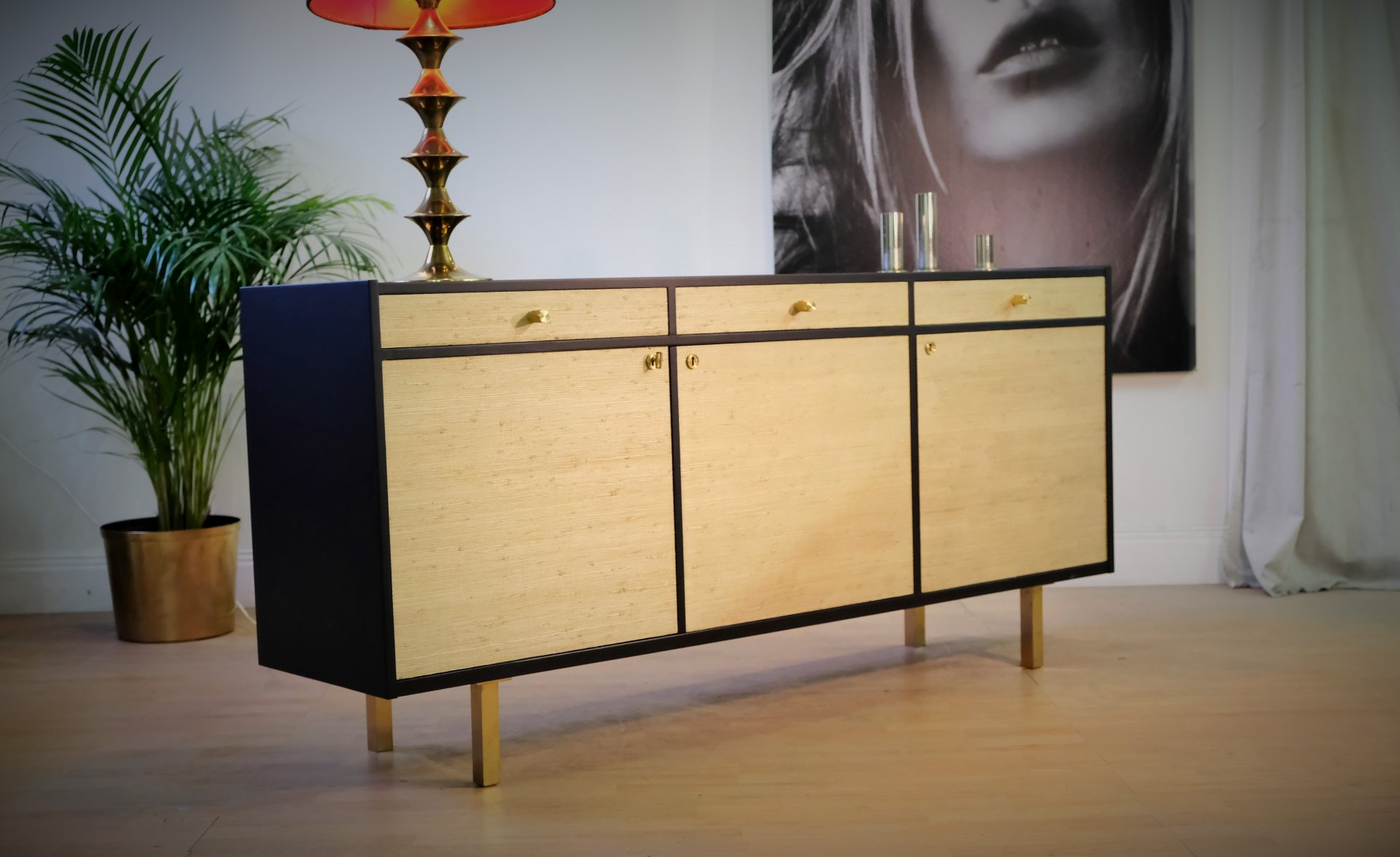
A good example of the vintage line is the black sideboard with seagrass from around 1960. It is painted matt black, with beige seagrass on the doors and drawers, a new glass top and solid brass handles by Buster and Punch; inside there are adjustable shelves. The dimensions are 170 x 80 x 42.5 cm and the price €1,400. The piece has been sold; an identical one can be sourced to order. Currently available, on the other hand, is the large sideboard with drinks cabinet from around 1960 with mirror, lighting, glass shelf and drawers (200 x 82 x 50 cm, €2,300); you can read more about this type in Sideboard with drinks cabinet.
What can go wrong with second-hand pieces
Anyone buying privately or at a flea market should check the following points. They apply to any piece of furniture of this age:
- Woodworm: Fresh piles of fine wood dust under a piece are a warning sign. Small old flight holes without dust are usually long since dealt with.
- Damp: Swollen bases, water marks or a smell of mould in the drawers are hard to remedy.
- Smells: Smoke and cellar damp soak into untreated wood. A piece from a smoking household can only be brought under control by sanding and repainting.
- Veneer damage: Bubbles and loose edges can be glued down; missing pieces must be replaced in the same wood.
- Missing fittings: Original handles are rarely available to buy again. Matching brass fittings can, however, be made new.
A restoration uncovers these problems and puts them right. How we go about it is described in Why restore instead of buying new.
A vintage sideboard in black
Old furniture often has a history of repairs, uneven veneer and differing finishes. Matt black paint turns these into a uniform, calm surface without blurring the character of the form. Brass goes well with it: it darkens over the years and complements the paint. How black looks in its variants is covered in Black sideboard. The article on the vintage chest of drawers shows how the same principle looks on a chest of drawers; the guide to Scandinavian vintage furniture offers a broader view of the periods. A painted sideboard like this is, in effect, an upcycled sideboard: the old piece is kept, and only its surface is renewed.
What a vintage sideboard costs
The range is wide. An unrestored piece from a flea market or a house clearance can be cheap, but it demands time and craftsmanship: sanding, repairing, painting, new fittings. A fully restored sideboard costs between €1,400 and €2,400 with us. The price depends on size, period and the effort involved. The seagrass sideboard, 170 cm wide, was priced at €1,400, the large Gustavian pieces, 185 to 200 cm wide, at €2,300 to €2,400. When comparing listings, always compare what the price includes: restoration, new finish, fittings, delivery.
Vintage in the home: how it looks
A good vintage sideboard does not need a matching setting, just a little restraint. Place it against a quiet wall, hang a large picture or a mirror above it and limit the decoration to a few objects. Vintage looks best in contrast with plain, modern furniture: a sofa with clean lines, an oak dining table, pale walls. An old piece with a history is more interesting in a modern room than in a set made up entirely of old things. The same goes for statement pieces, about which the article Statement furniture has more to say.
How to buy from us
In the Sideboards category you will find restored, one-of-a-kind pieces from a Swedish workshop, with prices between €1,400 and €2,400. You enquire without obligation, we clarify dimensions, condition and delivery with you, and payment is by arrangement. Delivery within Germany is free. You can reach us via Contact, and the terms are set out under Right of withdrawal and returns.
Frequently asked questions
What is the difference between vintage and retro?
Vintage is a genuine old piece of furniture; retro is a style that recalls earlier times and also occurs in new goods.
Is a vintage sideboard worth choosing over a new one?
Usually yes, if it is made of solid wood or good veneer and is in good condition. It lasts decades longer and keeps its value, whereas new chipboard goods quickly lose value.
How do I care for a restored vintage sideboard?
With a soft, slightly damp cloth. Do not put anything hot or wet directly on the top, and use felt pads under lamps and vases.
How can I tell that a sideboard is really old?
By dovetailed drawers on wooden runners, a recessed back panel, solid wood in the carcass and credible signs of use on the edges and legs.