
Sideboard Buying Guide: Dimensions, Styles, Periods and What to Look for
This guide explains what matters in a sideboard: dimensions, styles, colours and the difference between new furniture and a restored original.


A sideboard is a low, wide piece of furniture with doors and often drawers, which holds tableware, table linen, media and odds and ends in the living or dining room and offers space on top for lamps, pictures and flowers. Four things decide whether it suits you: the dimensions, the style, the colour and the construction. This guide explains them in turn, shows how a sideboard proves its worth in the living room and sets out the difference between a new piece made of chipboard and a restored original. At Plan B Design, a Swedish workshop, we restore and paint vintage sideboards from the 1920s to the 1960s in black, black and gold, or black and white.
What a sideboard is and what it is not
The terms are used generously in the trade. A workable distinction looks like this:
- Sideboard: low and wide, usually 70 to 90 cm high, with doors and drawers. It stands against the wall and serves as a serving piece in the living or dining room.
- Lowboard: even flatter, often 40 to 55 cm high, intended for the television and equipment. More on this in the section on placement below.
- Highboard: a sideboard on legs or with an additional superstructure, from about 100 cm in height. The boundary is fluid.
- Dresser: the older term for the same piece, usually with classic proportions and drawers above the doors. You will find old pieces under Antique sideboard and old dresser.
- Chest of drawers: narrower and taller, consisting mainly of drawers and more suited to the bedroom. Our guide to the chest of drawers explains the differences.
The transition is fluid, and with old furniture in particular the same piece goes by a different name depending on the dealer. Dimensions and function are what count, not the label.
The dimensions: width, height, depth
Start with the wall, not the piece of furniture. Measure the available width, the depth you can spare and the height of whatever is to hang or stand above it. These guideline values have proved their worth for sideboards:
| Dimension | Usual range | What matters |
|---|---|---|
| Width | 120 to 200 cm | About two thirds of the wall width, or a gap of 20 to 30 cm to neighbouring furniture, looks balanced |
| Height | 70 to 90 cm | Comfortable to use up to about hip height; under a window the top must not touch the windowsill |
| Depth | 35 to 50 cm | From 45 cm plates and bowls fit in comfortably; under 35 cm it stays with books and table linen |
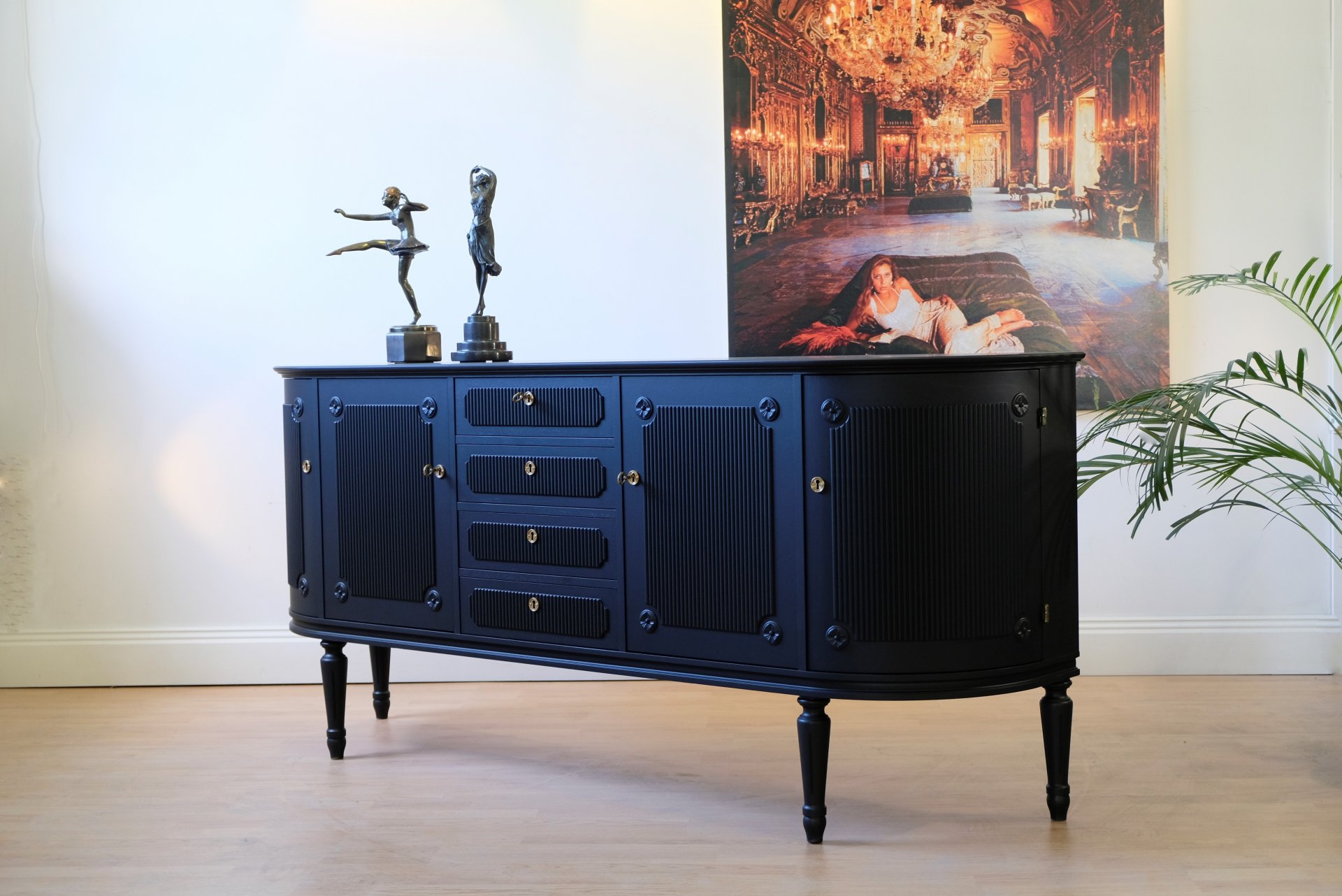
Our own pieces show how these values look on old furniture. The sideboard in the Gustavian style with brass fittings measures 185 x 81 x 44 cm, the Art Deco sideboard from around 1930 with a green and blue pattern 142 x 81 x 48 cm, the large sideboard with drinks cabinet 200 x 82 x 50 cm. All three fall within the range that has proved its worth for a hundred years.
Styles and periods at a glance
A sideboard tells the story of its time. Once you know the features, you can quickly tell what you are looking at even from a photo online.
| Style | Period | Identifying features | More |
|---|---|---|---|
| Gustavian | End of the 18th century, reproduced into the 20th century | Straight lines, symmetry, fluted legs, brass fittings | Scandinavian country style |
| Art Deco and Swedish Grace | 1920s and 1930s | Clear geometry, plinth, inlay or pattern, narrow decorative frames | Art Deco sideboard |
| Mid century | 1950s and 1960s | Slim legs, teak, plain fronts, handleless details | Mid century sideboard |
| Vintage and retro | 1950s to 1970s | Everyday furniture with a history, mixed materials such as seagrass or glass | Vintage and retro sideboards |
| Scandinavian | 1930s to 1960s | Pale or dark woods, reduced form, craftsmanship | Scandinavian sideboard |
How Swedish and Danish furniture differ is covered in the comparison Swedish or Danish furniture. A broader overview of origins and periods is given by the guide to Scandinavian vintage furniture. The Art Deco period is described in Art Deco furniture, and that of the 1950s and 1960s in Mid-century furniture.
Colour: why black so often wins
White sideboards are the most common search, but white shows every fingerprint and quickly makes old furniture look flat. Natural wood is lovely as long as the grain is even and the room is calm. Black, by contrast, emphasises the form, hides signs of use and ties a sideboard into almost any interior, from Scandinavian to industrial. There are three variants that we build regularly:
- Matt black, calm and modern. The surface forgives wear and lets brass and wood beside it stand out.
- Black with gold, with narrow frames around the doors and sides. This is the variant for rooms that can take a statement.
- Graphic black and white, with patterns in the Art Deco style, for homes with clean lines.
The article Black sideboard: matt, high gloss, with gold covers this in detail. Examples from our workshop are a sideboard from around 1930 with gold frame in matt black (€1,600, sold) and a teak sideboard with gold frames from around 1960 (€2,050, sold). An identical piece can be sourced to order. Because each of these has been repainted by us, they are painted sideboards in the true sense: upcycled furniture that keeps its old carcass.
Wood and construction: where quality lies
The type of wood says less than what lies beneath. Solid wood or laminated wood in the carcass, real veneer on the fronts and a recessed back panel are signs of good work. New goods for a few hundred euros, by contrast, almost always consist of coated chipboard with metal rails in the drawers. A guide by period:
- Pine under a painted finish is the basis of Gustavian furniture.
- Birch, often flame-figured, stands for Swedish Grace and the 1920s to 1940s.
- Mahogany belongs to Empire and Art Deco.
- Teak is the wood of Danish and Swedish furniture of the 1950s and 1960s.
- Oak characterises the first half of the 20th century and is the most common wood in new furniture.
The same applies to fittings. Solid brass, leather or twisted natural leather last longer than cast zinc. For many of our pieces, new handles in solid brass are part of the restoration; for the sideboard with brass fittings they were made by hand in Småland specially.
Finish and care
A matt paint is more robust than it looks, but calls for a few habits. Wipe the top with a soft, slightly damp cloth and avoid harsh or abrasive cleaners. Hot pans and wet glasses belong on coasters, and heavy vases and lamps on felt pads, so that the top does not get scratched. Small signs of use are less noticeable on black than on white or pale wood, and they can be touched up. If you ever want to redesign the piece, you can have it repainted later; with solid wood this is possible as often as you like and is one reason an old sideboard keeps its value. When transporting it, it is worth securing doors and drawers and never lifting the piece by its top.
Old sideboard or new?
The new sideboard has advantages: it is available at once and comes in many sizes. Against that are the drawbacks familiar to anyone who has ever assembled one. Chipboard swells with damp, drawers rattle after a few years, and the resale value is zero the day after purchase. An old sideboard from the first half of the century is built of solid wood, has dovetailed drawers and can be repainted as often as you like. It is a one-of-a-kind piece that holds its value over decades. With us the price lies between €1,400 and €2,400, depending on size, period and effort. How we work and why it is worthwhile is described in Why restore instead of buying new.
What to look for before buying
- The doors: They should close cleanly and not stick. Warped doors can be adjusted, but not every one.
- The drawers: Pull them all out. They must run smoothly, be dovetailed at the corners and have an intact base.
- The carcass: Press against a corner. If the piece wobbles, the glue joints are dry, which can be repaired.
- The inside: Shelves should be adjustable and not sag. At widths from 150 cm, a central divider is a good sign.
- The smell: Mould does not go away; old dust does.
- The measurements: Also check doors, stairwell and lift before ordering a piece 200 cm wide.
Placement and use
In the living room the sideboard usually stands along the longest free wall, beneath a picture or mirror, with about 5 to 10 cm of space from the wall because of the skirting board. In the dining room it holds tableware and table linen. In a hallway, 35 to 40 cm of depth is often enough. Anyone who wants to put a television on it needs a stable top and a height at which the screen stays at eye level when seated; a low sideboard of 70 to 80 cm is usually better for this than one of 90 cm. The article Living room sideboard offers practical advice. A sideboard that doubles as a home bar is described in Sideboard with drinks cabinet, and anyone looking for a classic drinks cabinet will find it in the drinks cabinet buying guide. A display cabinet on the neighbouring wall or a chest of drawers in the hallway makes a good complement.
How to buy from us
All sideboards in the Sideboards category are restored, one-of-a-kind pieces from our Swedish workshop. You enquire without obligation, we clarify dimensions, condition and delivery with you, and payment is by arrangement. Delivery within Germany is free. If the piece you want has already been sold, a similar or identical one can be sourced to order; we are happy to help you find the right shade for your interior. You can reach us via Contact, and the terms are set out under Right of withdrawal and returns. Currently available, for example, are the Gustavian sideboard in matt black (€2,400), the Art Deco sideboard from around 1930 (€2,050) and the sideboard with drinks cabinet (€2,300).
Frequently asked questions
How high should a sideboard be?
For everyday use, 70 to 90 cm is comfortable. Under a window the height of the windowsill counts; with a television on top, the piece should be on the low side.
What is the difference between a sideboard and a chest of drawers?
A sideboard is wider and lower and usually has doors; a chest of drawers is taller and narrower and consists mainly of drawers. With old furniture the two terms overlap.
Which colour suits most rooms?
Black, matt or with narrow gold frames, can be combined with both pale and dark walls and barely shows signs of use. White quickly looks flat on old furniture.
Can I use a sideboard with a television?
Yes, if the top is stable and deep enough. A sideboard 70 to 80 cm high is usually better for sitting on the sofa than a taller model.