

Styling a Display Cabinet: How to Fill It Like an Exhibition
A display cabinet is the only piece of furniture that shows its contents around the clock, and therefore the only one in which the contents are part of the piece. A beautiful cabinet with the wrong contents looks like a storeroom; a simple cabinet with the right contents looks like an exhibition. The difference lies not in what you own but in how it is arranged. This article sets out the rules we use when photographing our cabinets and when filling them with customers, in the living room and in the kitchen. It is part of our large guide to the display cabinet.
Rule one: only half
Take everything out, put half back. A display cabinet needs air: at least a third of each shelf free, and between the objects a gap as large as the objects themselves. What does not fit belongs in the closed base cupboard, in a drawer or with someone else. The difficult part is not choosing what stands at the front but accepting that the rest does not.
Rule two: groups in odd numbers, heights staggered
Arrange objects in groups of three or five, never in a row and never in pairs, unless the pair is the point: two candlesticks, two decanters. Within the group the heights should vary, one tall, one medium, one low object, so that the eye travels. The tallest stands at the back or in the middle, never at the edge. A row of plates stood on edge is the exception, the classic look of the china cabinet, and works only if all the plates are the same. Do not mix row and group on the same shelf.
Rule three: one colour per shelf or one for the whole cabinet
A display cabinet with everything you own, in all colours, is disorder behind glass. Choose: either one colour family for the whole cabinet, white porcelain and clear glass, or one colour per shelf, so that each shelf makes a picture of its own. Metal counts as a colour: brass and gold on one shelf, silver and pewter on another, never mixed. Books work in display cabinets only if the spines are sorted by colour or all share the same tone, leather or linen. For display cabinet decoration that means: a few good pieces rather than many small ones.
Rule four: the interior is the backdrop
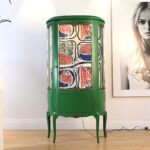
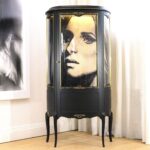
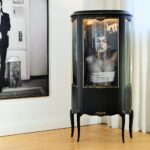
All of the above presupposes a backdrop against which the objects are visible. Light objects against a dark interior, dark ones against a light one, see the colour guide to the display cabinet and Black display cabinet. A patterned interior, fabric, wallpaper or photographic art, needs fewer objects because the backdrop is already a picture. A cabinet like the green display cabinet with a Josef Frank motif needs only three to five objects per shelf. The light does the rest, see Display cabinet with lighting.
The display cabinet in the living room
In the living room the display cabinet is a picture, not storage. The contents should be what you want to look at: glass, ceramics, a collection, a few books, a photograph leaning against the back panel. By all means mix materials, glass and ceramics and wood, but keep to the colour. Do not put in what you use every day: doors that are opened ten times a day are doors that will eventually hang. The place is centrally on the wall you see from the sofa, see the guide. For small rooms, a narrow display cabinet or a low display cabinet under a picture is the solution. Anyone looking for a display cabinet for the living room should also check how much daylight falls on the glass.
The display cabinet in the dining room and kitchen
In the dining room the display cabinet is the original: the china cabinet in which the porcelain you use stands behind glass, visible and dust-free. Here it may be fuller, but sorted: plates in stacks of the same kind, glasses in rows of the same kind, cups with the handles in the same direction. A display cabinet for the kitchen is one of the most common searches, and what is often meant are built-in glass-fronted cabinets or kitchen cupboards with a glass door. A freestanding old display cabinet in the kitchen does the same with more character and can be taken with you when the kitchen is renewed. A low cabinet under a window or a narrow one by the door are the best places. Choose a cabinet that can take being opened: sturdy hinges and glass shelves that carry plates, 8 mm. A cabinet of wood or in grey suits most kitchens, see Wooden display cabinet.
Six things for the display cabinet and three to leave out
- Glass and crystal: glows the most and benefits the most from the light.
- White or single-colour porcelain in stacks and rows.
- A collection, no matter what, as long as it is the same thing: stones, shells, ceramics by a single potter.
- Books, sorted by colour, lying in stacks of three to five.
- A single large object per shelf: a vase, a sculpture, a hat.
- Brass and silver, each on a shelf of its own.
- Leave out: plastic, packaging and anything with text other than book spines.
- Leave out: framed photographs in more than one copy. One against the back panel is lovely; five make a chest of drawers.
- Leave out: plants. They die behind glass and drip onto the shelf below.
Frequently asked questions
How many objects should stand on each shelf?
Three to seven, in one or two groups, with at least a third of the shelf free.
Should glasses stand upright or upside down in the display cabinet?
Upright if the cabinet is closed and dust-free, upside down only on open shelves. Alternating upside down and upright is the china cabinet’s way of saving space, and it looks like it.
Can a display cabinet stand in the kitchen without getting greasy?
Yes, if it stands at least two metres from the hob and the doors close tightly. Old cabinets with loose doors need new sealing strips, which is included in our restoration. See current display cabinets.