
Swedish Grace in Modern Interiors: How to Use the Style Today


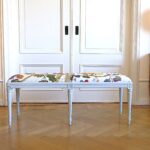

Swedish Grace works unusually well in modern homes. This is because the style combines classic proportions with a calmer and more pared-down expression than many other historical design styles. The result is an interior that feels elegant and considered without seeming heavy or overworked.
In today’s homes, Swedish Grace is often used to create balance. The piece or the room is welcome to feel sophisticated, but never stiff. It is precisely in the meeting between classic form and modern simplicity that the style becomes most interesting.
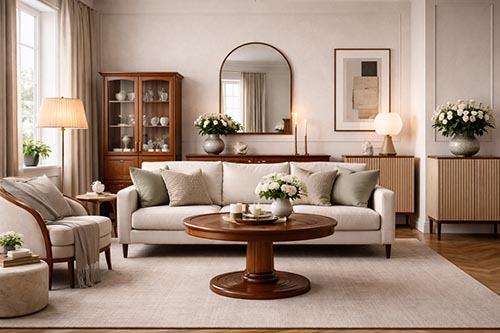
What Characterises Swedish Grace in a Modern Home?
When Swedish Grace is interpreted in a modern interior, it is seldom a matter of recreating an entire historical room. Instead, the principles of the style (symmetry, feeling for material, proportions and restrained elegance) are used to create a clear but timeless whole.
- Soft, balanced proportions
- Natural materials such as wood, stone and textiles
- Discreet but well-chosen details
- A colour palette that feels calm and harmonious
- Furniture that gives weight without dominating
If you first want to understand the background of the style itself, you can read: What is Swedish Grace?
How to Use Swedish Grace in the Living Room
In the living room, Swedish Grace works particularly well through furniture that creates structure and calm. A cabinet, a sideboard or a round table with well-judged proportions can give the room a clear foundation to build on.
The style suits rooms especially well where you want to combine modern comfort with a more classic character. A few pieces of furniture with the right form and material often make a greater difference than many decorative objects.
Materials and Colours That Strengthen the Feeling
Swedish Grace relies heavily on the quality of the materials. Wood with a beautiful grain, stone, brass and textiles in natural tones strengthen the expression. The colour palette should be soft and cohesive: off-white, grey, warm beige, muted greens or darker woods work particularly well.
If you would like to delve deeper into this, you can read: Materials and details in Swedish Grace.
Swedish Grace and Redesigned Furniture
One of the most interesting ways of working with Swedish Grace today is through older furniture that is given a new life. Much furniture with classic proportions can, through renovation and redesign, be given an expression close to Swedish Grace, without becoming pastiche or outright copies.
That is also why redesigned furniture works so well where you want to unite history, craftsmanship and modern use.
The Difference From More Decorative Styles
Swedish Grace is sometimes compared with Art Deco because both styles are built on a strong sense of form and awareness of materials. But where Art Deco often works more with contrasts, graphics and a more obviously decorative expression, Swedish Grace is calmer, softer and more restrained.
Read more in our comparison: Swedish Grace vs Art Deco.
A Style That Lasts Over Time
What makes Swedish Grace so useful in modern interiors is that the style is not built on fast trends. It is built on principles that still feel relevant: good proportions, quality materials and a sense of balance.
For many people this is precisely why the style continues to inspire: it makes it possible to create homes that feel personal, harmonious and timeless.
If you would like to read more about the design language and furniture of the style itself, you can also see: Swedish Grace furniture and design language.
Room by Room: How to Place Swedish Grace
In the hallway, a tall, narrow chest of drawers looks best, with a mirror above it and two brass hooks beside it. In the living room, a drinks cabinet or sideboard as a standout piece against a calm wall is the right move, see Drinks cabinet in the living room. In the bedroom, two bedside tables in the style are the simplest way in, together with a low chest of drawers. In the dining room, a display cabinet for glass and porcelain suits, preferably lit. The rule everywhere: one Swedish Grace piece per room is enough to set the tone. More turns it into a museum.
The Colour Palette That Carries the Style
The original rooms were warm and muted: ochre, olive green, brick red, grey-blue and plenty of untreated wood. That still works. For a modern interpretation we recommend walls in warm white or greige that let the veneer or black lacquer of the piece speak, an accent wall in deep green or blue behind the most important piece, and textiles in linen and wool in natural tones. Avoid cold white and strong colours, as they make the style thin. Our own signature, black lacquer with brass on old forms, is described in Black drinks cabinet and Redesigned furniture.
Frequently Asked Questions
Does Swedish Grace go with IKEA?
Yes, unusually well in fact. Simple, light basic furniture is the best background for a single strong Swedish Grace piece.
Which lighting suits it?
Warm light, 2,700 kelvin, from floor and table lamps rather than from the ceiling. Brass and opal glass are the lamps of the style.
Can Swedish Grace be mixed with mid-century?
Yes, if both have the same finish. Painted black, a chest of drawers from the 1920s and a sideboard from the 1960s become a family. More in the article Mid-century furniture.