
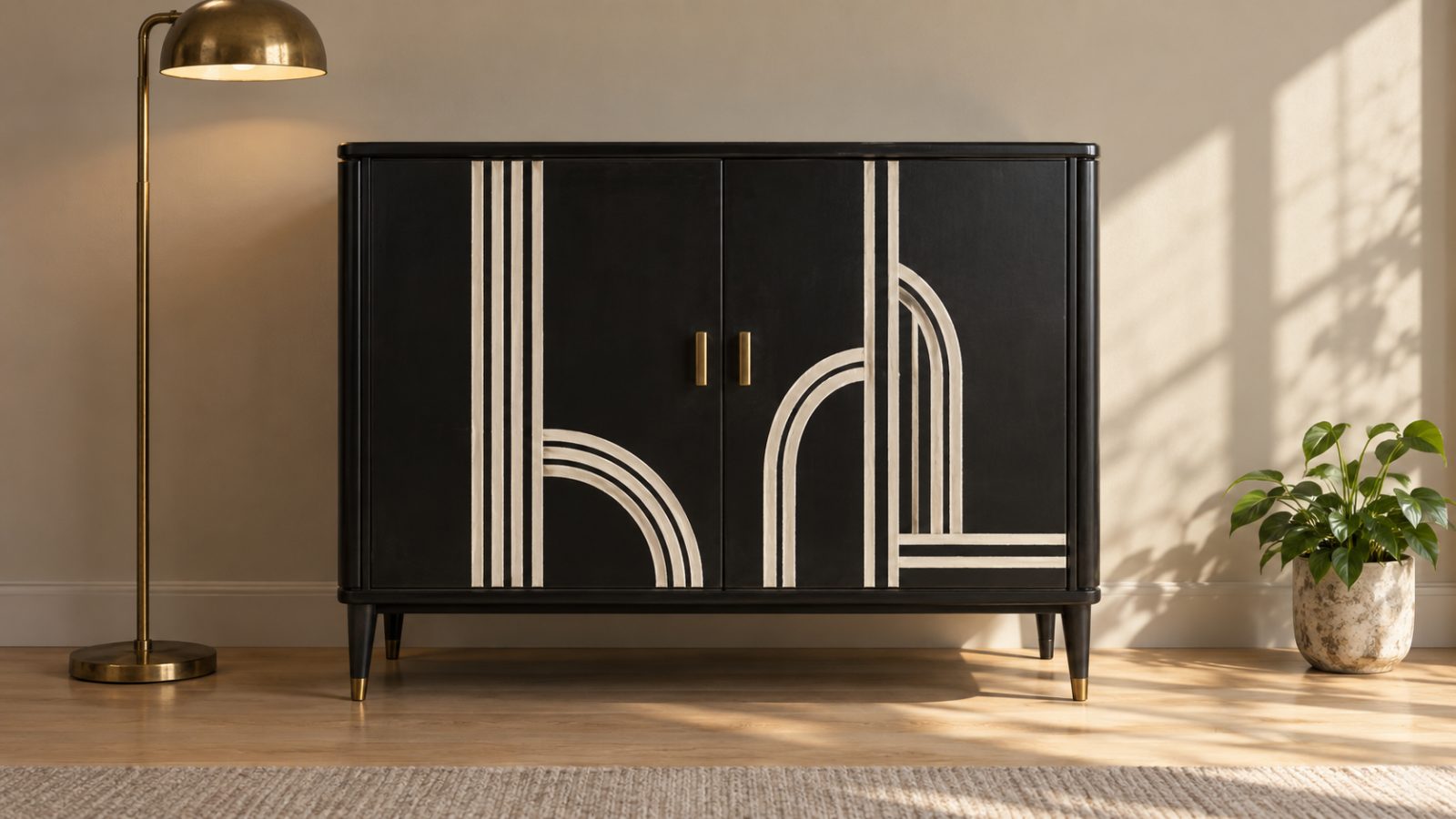
Black Drinks Cabinet: Why Black Is the Strongest Colour for a Home Bar



A black drinks cabinet is the safest and at the same time the strongest decision you can make for a home bar. Black lets the form speak, goes with almost any wall colour and turns the lit interior into an event when opened. In this article we explain why we lacquer almost all drinks cabinets black at Plan B Design, how black can be combined with white, gold and brass, and which wall colours and floors go with it. You will find the overview of types and eras in the drinks cabinet guide.
Why black works for a drinks cabinet
A drinks cabinet has two states: closed and open. Closed, it should be a calm piece of furniture; open, a stage. Black does both. As a surface it recedes and shows only the silhouette of the piece, which on old pieces from the 1930s to the 1960s is almost always beautiful. When opened, the black front becomes a frame for mirror, brass and glass. The contrast is greater than with any wood tone. There is also a practical reason: black dissolves the dating. A teak cabinet is instantly “sixties”; a black-lacquered cabinet is simply a design object that belongs in a contemporary interior. How this looks in modern rooms is shown in the article Furnishing with a modern drinks cabinet.
Matt or glossy?
High gloss is the classic choice for Art Deco and Swedish Grace. The lacquer mirrors the room, emphasises curved fronts and feels festive. Drawback: fingerprints and scratches show, and the surface needs care. Satin matt is the choice for Swedish Modern and Retro. The lacquer absorbs light, the form looks more graphic and signs of use are hardly noticeable. Most of our pieces are lacquered satin matt, like the black and white drinks cabinet in the Swedish Modern style, circa 1940. A deep off-black, a black with a hint of brown or green, is softer than pure black and goes particularly well with brass and warm wood.
Black and white: the graphic pattern
Anyone looking for a white drinks cabinet is usually looking for brightness and contrast. Pure white, however, quickly makes an old piece look flat and lets scratches and yellowing show through. Our answer is black and white: a black carcass with a hand-painted white pattern on the fronts, geometric, striped or as a signature motif. This gives the cabinet the brightness of white while keeping the depth of black. Three examples from the workshop:
- Black and white patterned drinks cabinet, Swedish Modern, 1940s: an all-over graphic pattern across both doors.
- Black and white drinks cabinet, Swedish Grace, 1940s: fine white lines on a classical form.
- Black and white drinks cabinet, vintage 1960s: a retro carcass on legs, with the pattern as a contrast to the plain form.
Black and gold: gold leaf, brass, gold diamonds
Gold on black is the combination that turns a drinks cabinet into a luxury piece without it becoming loud. We use three techniques: gold leaf, genuinely gilded surfaces or panels on the fronts, as on the drinks cabinet with gold leaf in the Swedish Modern style. Brass fittings, handles, profiles and edges, which acquire a patina over the years. And painted gold patterns, such as the diamonds on the drinks cabinet with gold diamonds from the 1960s. The rule: one gold technique per piece. Gold leaf and a painted pattern at the same time look overloaded. What else materials and workmanship reveal about quality, you can read in the article on the luxury drinks cabinet.
Wall colour, floor and light for the black drinks cabinet
Walls: Warm white, greige, sand or a deep green give black warmth. Cold pure white makes it harsh, mid grey takes away the contrast. A dark wall, such as fir green or midnight blue, makes a black drinks cabinet almost disappear so that only the gold details glow, a very elegant effect in rooms with plenty of daylight. Floors: Oak, pine and pale stone floors make the best backdrop. On dark parquet the cabinet needs legs or a pale rug, otherwise it merges with the floor. Light: A light above or beside the cabinet, not in front of it, so that the lacquer does not throw reflections. How to place the cabinet in the room is covered in the article Drinks cabinet in the living room.
Caring for a black-lacquered drinks cabinet
Black lacquer shows dust more clearly than wood, but not water marks. Wipe with a soft, slightly damp microfibre cloth, without silicone polish and without abrasives. Small scratches on satin matt lacquer can be disguised with a black furniture touch-up pen; on high gloss, only by polishing. Wipe gold leaf and brass dry. Avoid direct sunlight, which makes lacquer go dull. A well-restored drinks cabinet needs no further treatment for decades with this care. You will find all available black and black and white pieces in the Drinks cabinets category.
Frequently asked questions
Does a black drinks cabinet look too heavy in a small room?
Not if it stands on legs and the wall behind is pale. A cabinet that floats 20 cm above the floor looks lighter than a pale cabinet with a plinth. For very small rooms we recommend a small drinks cabinet in satin matt.
Can I combine a black drinks cabinet with pale furniture?
Yes, that is the classic combination: a black solitary piece, a pale sofa, an oak floor. Repeat black in one small place in the room, such as a light or a picture frame, and the cabinet looks anchored rather than isolated.
Can you still see the wood under black lacquer?
Not with opaque lacquer; the grain disappears. If you want to keep it, choose a black stain or glaze that lets the wood show through. This works best on open-pored woods such as oak and ash, less well on mahogany.